Thalia Brookstone is a nonfiction author known for writing reflective books on psychology, personal growth, and emotional balance. Her work blends modern behavioral insights with calm, thoughtful storytelling, encouraging readers to approach life with greater self-awareness, resilience, and clarity.
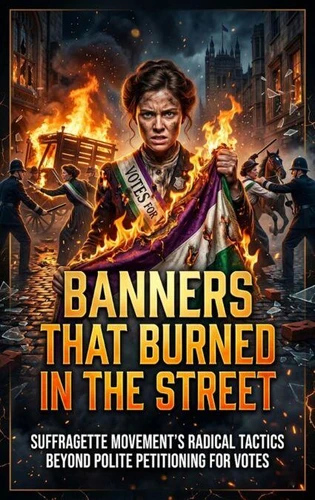
Banners That Burned in the Street. Suffragette Movement's Radical Tactics Beyond Polite Petitioning for Votes
Par :Formats :
Disponible dans votre compte client Decitre ou Furet du Nord dès validation de votre commande. Le format ePub est :
- Compatible avec une lecture sur My Vivlio (smartphone, tablette, ordinateur)
- Compatible avec une lecture sur liseuses Vivlio
- Pour les liseuses autres que Vivlio, vous devez utiliser le logiciel Adobe Digital Edition. Non compatible avec la lecture sur les liseuses Kindle, Remarkable et Sony
 , qui est-ce ?
Notre partenaire de plateforme de lecture numérique où vous retrouverez l'ensemble de vos ebooks gratuitement
Pour en savoir plus sur nos ebooks, consultez notre aide en ligne ici
C'est si simple ! Lisez votre ebook avec l'app Vivlio sur votre tablette, mobile ou ordinateur :

- Nombre de pages157
- FormatePub
- ISBN978-3-565-46100-4
- EAN9783565461004
- Date de parution26/05/2026
- Protection num.pas de protection
- Taille2 Mo
- Infos supplémentairesepub
- ÉditeurEmphaloz Publishing House
Résumé
This book investigates how the suffragette movement exchanged decorum for disruption, probing the moment when women traded petitions and polite appeals for window-smashing, arson, and public confrontation. It traces the evolution of militant tactics-from chaining themselves to railings and storming Parliament to conducting a coordinated bombing and arson campaign-asking why, after decades of constitutional lobbying, a growing number of women chose to make their bodies and their rage the central instruments of pressure.
Drawing on police files, prison records, and suffragette memoirs, the book reconstructs the mechanics of their activism: the use of public demonstrations, hunger strikes, and secret cells; the way women learned jujitsu and self-defense to confront police violence; and the calculated staging of property damage that targeted symbols of power rather than people.
It also examines how the press and state authorities framed these women as "hysterical" or "unladylike, " exposing the gendered logic that condemned their aggression while accommodating similar tactics when performed by men in political conflicts.
It also examines how the press and state authorities framed these women as "hysterical" or "unladylike, " exposing the gendered logic that condemned their aggression while accommodating similar tactics when performed by men in political conflicts.