Thalia Brookstone is a nonfiction author known for writing reflective books on psychology, personal growth, and emotional balance. Her work blends modern behavioral insights with calm, thoughtful storytelling, encouraging readers to approach life with greater self-awareness, resilience, and clarity.
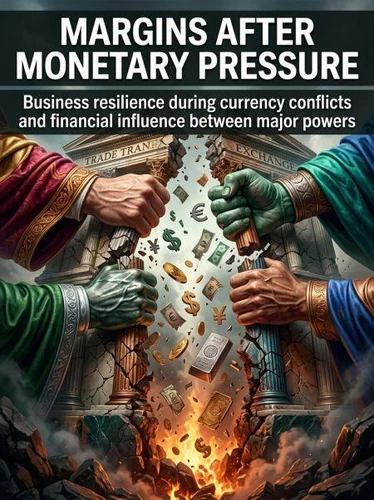
Margins After Monetary Pressure. Business resilience during currency conflicts and financial influence between major powers
Par :Formats :
Disponible dans votre compte client Decitre ou Furet du Nord dès validation de votre commande. Le format ePub est :
- Compatible avec une lecture sur My Vivlio (smartphone, tablette, ordinateur)
- Compatible avec une lecture sur liseuses Vivlio
- Pour les liseuses autres que Vivlio, vous devez utiliser le logiciel Adobe Digital Edition. Non compatible avec la lecture sur les liseuses Kindle, Remarkable et Sony
 , qui est-ce ?
Notre partenaire de plateforme de lecture numérique où vous retrouverez l'ensemble de vos ebooks gratuitement
Pour en savoir plus sur nos ebooks, consultez notre aide en ligne ici
C'est si simple ! Lisez votre ebook avec l'app Vivlio sur votre tablette, mobile ou ordinateur :

- Nombre de pages142
- FormatePub
- ISBN978-3-565-48065-4
- EAN9783565480654
- Date de parution06/06/2026
- Protection num.pas de protection
- Taille1 Mo
- Infos supplémentairesepub
- ÉditeurEmphaloz Publishing House
Résumé
Business resilience is increasingly determined by forces outside traditional competition. Currency influence, financial restrictions, and monetary alliances now affect supply chains, investment decisions, and market access with growing intensity.
This book investigates how monetary power influences international business. It focuses on the ways financial influence alters corporate planning long before visible political conflicts emerge.
The discussion centers on three operational realities.
Financial dependence on dominant currencies creates structural exposure. Capital allocation increasingly reflects geopolitical priorities rather than purely economic calculations. Regulatory fragmentation across major economic blocs introduces new uncertainty into long-term investment planning. The result is a business environment where financial systems function as channels of strategic influence.
Executives must evaluate not only operational efficiency but also exposure to monetary pressure originating far beyond their industry. Rather than predicting future crises, the book provides a framework for understanding why financial shocks travel rapidly through interconnected markets. It highlights the mechanisms that transform political competition into measurable business consequences. Across Europe and global export markets, organizations face a period where financial stability and geopolitical alignment increasingly overlap.
Understanding that intersection has become essential for strategic planning.
Financial dependence on dominant currencies creates structural exposure. Capital allocation increasingly reflects geopolitical priorities rather than purely economic calculations. Regulatory fragmentation across major economic blocs introduces new uncertainty into long-term investment planning. The result is a business environment where financial systems function as channels of strategic influence.
Executives must evaluate not only operational efficiency but also exposure to monetary pressure originating far beyond their industry. Rather than predicting future crises, the book provides a framework for understanding why financial shocks travel rapidly through interconnected markets. It highlights the mechanisms that transform political competition into measurable business consequences. Across Europe and global export markets, organizations face a period where financial stability and geopolitical alignment increasingly overlap.
Understanding that intersection has become essential for strategic planning.