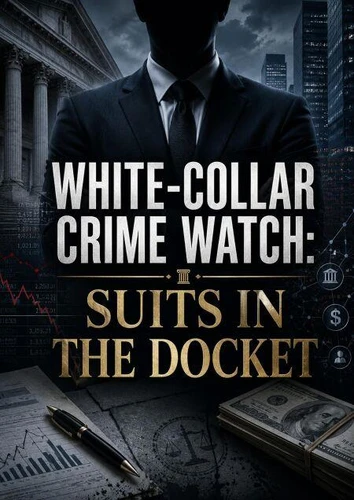
White-Collar Crime Watch: Suits in the Docket
Par :Formats :
Disponible dans votre compte client Decitre ou Furet du Nord dès validation de votre commande. Le format ePub est :
- Compatible avec une lecture sur My Vivlio (smartphone, tablette, ordinateur)
- Compatible avec une lecture sur liseuses Vivlio
- Pour les liseuses autres que Vivlio, vous devez utiliser le logiciel Adobe Digital Edition. Non compatible avec la lecture sur les liseuses Kindle, Remarkable et Sony
 , qui est-ce ?
Notre partenaire de plateforme de lecture numérique où vous retrouverez l'ensemble de vos ebooks gratuitement
Pour en savoir plus sur nos ebooks, consultez notre aide en ligne ici
C'est si simple ! Lisez votre ebook avec l'app Vivlio sur votre tablette, mobile ou ordinateur :

- FormatePub
- ISBN8235496293
- EAN9798235496293
- Date de parution21/05/2026
- Protection num.pas de protection
- Infos supplémentairesepub
- ÉditeurIoakim Ioakim
Résumé
White-Collar Crime Watch: Suits in the Docket is a thoughtful and powerful exploration of the hidden world of financial, corporate, professional, and institutional wrongdoing. Unlike ordinary crimes that often appear through visible violence or direct theft, white-collar crimes usually operate behind polished offices, official documents, legal language, banking systems, digital records, professional titles, and respectable appearances.
This book examines how crime may wear a suit, speak with authority, and move through trusted institutions while silently harming individuals, businesses, markets, governments, and society at large. The book begins by explaining the meaning and nature of white-collar crime, showing how it differs from traditional crime and why it is often more difficult to detect. It highlights the mask of respectability that allows powerful offenders to hide behind education, reputation, professional status, wealth, and influence.
Through clear and bookish discussion, the work reveals that crime is not made less serious because it is committed through documents rather than weapons, or through offices rather than streets. Across its chapters, the book studies major forms of white-collar crime, including corporate fraud, banking fraud, bribery, corruption, insider trading, market manipulation, money laundering, tax evasion, cyber financial crimes, professional misconduct, consumer fraud, and commercial cheating.
Each chapter explains how these crimes are committed, how they are concealed, who suffers from them, and why they are dangerous to public trust. The book shows that white-collar crime is not victimless. Its victims may include investors, employees, consumers, depositors, taxpayers, patients, clients, honest businesses, and ordinary citizens. A major strength of the book is its focus on trust. Banks, companies, markets, governments, professions, and digital platforms all depend upon trust to function.
When that trust is abused, the damage spreads far beyond one transaction. False accounts can destroy investments. Corrupt contracts can weaken public development. Hidden income can reduce public welfare. Insider trading can damage market fairness. Professional misconduct can betray clients. Cyber fraud can steal identity, money, and confidence. The book also explores the detection and investigation of white-collar crime.
It discusses the role of auditors, forensic accountants, regulators, investigators, whistleblowers, digital evidence, financial records, and courts. Special attention is given to whistleblowers, whose courage often brings hidden misconduct into the light. The courtroom, or "the docket, " becomes a symbol of accountability, where polished appearances must finally answer to evidence. The later chapters examine punishment, recovery, restitution, prevention, ethics, and future challenges.
The book argues that justice must not stop at conviction; stolen assets must be recovered, victims must be compensated, dishonest professionals must be disciplined, and broken systems must be reformed. It also emphasizes that prevention requires ethical leadership, strong compliance, transparent governance, cyber security, public awareness, and a culture that values integrity above profit. Written in a serious and accessible style, White-Collar Crime Watch: Suits in the Docket is suitable for students, legal readers, business professionals, investigators, policymakers, and general readers interested in crime, law, finance, governance, and ethics.
It is a compelling reminder that no title, office, fortune, or suit should ever place anyone above the law.
This book examines how crime may wear a suit, speak with authority, and move through trusted institutions while silently harming individuals, businesses, markets, governments, and society at large. The book begins by explaining the meaning and nature of white-collar crime, showing how it differs from traditional crime and why it is often more difficult to detect. It highlights the mask of respectability that allows powerful offenders to hide behind education, reputation, professional status, wealth, and influence.
Through clear and bookish discussion, the work reveals that crime is not made less serious because it is committed through documents rather than weapons, or through offices rather than streets. Across its chapters, the book studies major forms of white-collar crime, including corporate fraud, banking fraud, bribery, corruption, insider trading, market manipulation, money laundering, tax evasion, cyber financial crimes, professional misconduct, consumer fraud, and commercial cheating.
Each chapter explains how these crimes are committed, how they are concealed, who suffers from them, and why they are dangerous to public trust. The book shows that white-collar crime is not victimless. Its victims may include investors, employees, consumers, depositors, taxpayers, patients, clients, honest businesses, and ordinary citizens. A major strength of the book is its focus on trust. Banks, companies, markets, governments, professions, and digital platforms all depend upon trust to function.
When that trust is abused, the damage spreads far beyond one transaction. False accounts can destroy investments. Corrupt contracts can weaken public development. Hidden income can reduce public welfare. Insider trading can damage market fairness. Professional misconduct can betray clients. Cyber fraud can steal identity, money, and confidence. The book also explores the detection and investigation of white-collar crime.
It discusses the role of auditors, forensic accountants, regulators, investigators, whistleblowers, digital evidence, financial records, and courts. Special attention is given to whistleblowers, whose courage often brings hidden misconduct into the light. The courtroom, or "the docket, " becomes a symbol of accountability, where polished appearances must finally answer to evidence. The later chapters examine punishment, recovery, restitution, prevention, ethics, and future challenges.
The book argues that justice must not stop at conviction; stolen assets must be recovered, victims must be compensated, dishonest professionals must be disciplined, and broken systems must be reformed. It also emphasizes that prevention requires ethical leadership, strong compliance, transparent governance, cyber security, public awareness, and a culture that values integrity above profit. Written in a serious and accessible style, White-Collar Crime Watch: Suits in the Docket is suitable for students, legal readers, business professionals, investigators, policymakers, and general readers interested in crime, law, finance, governance, and ethics.
It is a compelling reminder that no title, office, fortune, or suit should ever place anyone above the law.
A propos de Dilip Kumar Agrawal


2,99 €

2,99 €

2,99 €

2,99 €
2,99 €

2,99 €

2,99 €

2,99 €
2,99 €
2,99 €
2,99 €



2,99 €