Nouveauté
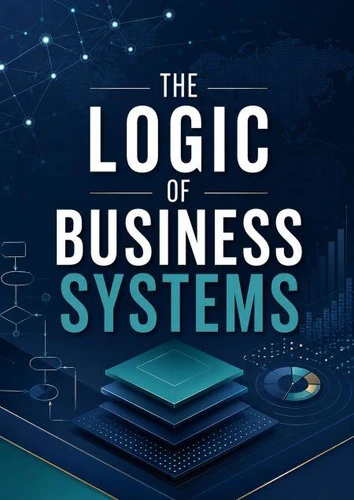
The Logic of Business Systems
Par :Formats :
Disponible dans votre compte client Decitre ou Furet du Nord dès validation de votre commande. Le format ePub est :
- Compatible avec une lecture sur My Vivlio (smartphone, tablette, ordinateur)
- Compatible avec une lecture sur liseuses Vivlio
- Pour les liseuses autres que Vivlio, vous devez utiliser le logiciel Adobe Digital Edition. Non compatible avec la lecture sur les liseuses Kindle, Remarkable et Sony
 , qui est-ce ?
Notre partenaire de plateforme de lecture numérique où vous retrouverez l'ensemble de vos ebooks gratuitement
Pour en savoir plus sur nos ebooks, consultez notre aide en ligne ici
C'est si simple ! Lisez votre ebook avec l'app Vivlio sur votre tablette, mobile ou ordinateur :

- FormatePub
- ISBN8235821835
- EAN9798235821835
- Date de parution31/05/2026
- Protection num.pas de protection
- Infos supplémentairesepub
- ÉditeurIoakim Ioakim
Résumé
The Logic of Business Systems is a comprehensive and insightful guide to understanding business as a living, interconnected, and purposeful system. Rather than viewing business as a collection of separate departments or isolated activities, this book presents enterprise as a complete structure of people, resources, decisions, processes, markets, technology, finance, ethics, and growth. It explains how every part of a business affects every other part, and how success depends on the intelligent coordination of these connected forces.
The book begins by introducing the idea of business as a system of inputs, processes, outputs, and feedback. It shows that business is not merely buying, selling, or earning profit, but a disciplined method of creating value for customers and society. It explores the deeper foundations of business logic, including cause and effect, planning, rational decision-making, resource allocation, and disciplined execution.
A major theme of the book is the role of purpose. Vision, mission, and values are presented as the inner compass of enterprise. The book explains how a clear purpose gives direction to strategy, strength to culture, and meaning to daily work. It also examines organizational structure, showing how roles, responsibilities, authority, communication, and accountability shape the performance of the business system.
The book gives careful attention to resources and capabilities, explaining that money, technology, people, knowledge, and physical assets become valuable only when they are organized into productive capability. It then turns outward to markets and customers, showing how businesses must understand customer needs, expectations, behavior, satisfaction, loyalty, and value perception in order to remain relevant and competitive.
Through detailed chapters on products, services, operations, finance, marketing, leadership, and culture, the book provides a complete view of how business systems function in practice. It explains how value is created through products and services, how operations turn promises into performance, how finance gives discipline to ambition, and how marketing communicates value to the market. It also highlights the importance of leadership, management, teamwork, organizational behavior, and workplace culture in shaping business success.
The later chapters focus on strategy, technology, risk, ethics, growth, and the future of enterprise. The book discusses competitive advantage, digital transformation, artificial intelligence, resilience, corporate governance, social responsibility, scalability, and future-ready business thinking. It emphasizes that modern businesses must not only grow, but grow responsibly; not only adopt technology, but use it wisely; not only pursue profit, but protect trust.
Written in clear and bookish language, The Logic of Business Systems is suitable for students, entrepreneurs, managers, professionals, and anyone who wants to understand how businesses truly work. It offers a broad yet practical framework for seeing enterprise as an organized system of value creation. Above all, this book teaches that lasting business success comes from alignment-between purpose and strategy, resources and capabilities, customers and value, leadership and culture, growth and responsibility.
The book begins by introducing the idea of business as a system of inputs, processes, outputs, and feedback. It shows that business is not merely buying, selling, or earning profit, but a disciplined method of creating value for customers and society. It explores the deeper foundations of business logic, including cause and effect, planning, rational decision-making, resource allocation, and disciplined execution.
A major theme of the book is the role of purpose. Vision, mission, and values are presented as the inner compass of enterprise. The book explains how a clear purpose gives direction to strategy, strength to culture, and meaning to daily work. It also examines organizational structure, showing how roles, responsibilities, authority, communication, and accountability shape the performance of the business system.
The book gives careful attention to resources and capabilities, explaining that money, technology, people, knowledge, and physical assets become valuable only when they are organized into productive capability. It then turns outward to markets and customers, showing how businesses must understand customer needs, expectations, behavior, satisfaction, loyalty, and value perception in order to remain relevant and competitive.
Through detailed chapters on products, services, operations, finance, marketing, leadership, and culture, the book provides a complete view of how business systems function in practice. It explains how value is created through products and services, how operations turn promises into performance, how finance gives discipline to ambition, and how marketing communicates value to the market. It also highlights the importance of leadership, management, teamwork, organizational behavior, and workplace culture in shaping business success.
The later chapters focus on strategy, technology, risk, ethics, growth, and the future of enterprise. The book discusses competitive advantage, digital transformation, artificial intelligence, resilience, corporate governance, social responsibility, scalability, and future-ready business thinking. It emphasizes that modern businesses must not only grow, but grow responsibly; not only adopt technology, but use it wisely; not only pursue profit, but protect trust.
Written in clear and bookish language, The Logic of Business Systems is suitable for students, entrepreneurs, managers, professionals, and anyone who wants to understand how businesses truly work. It offers a broad yet practical framework for seeing enterprise as an organized system of value creation. Above all, this book teaches that lasting business success comes from alignment-between purpose and strategy, resources and capabilities, customers and value, leadership and culture, growth and responsibility.
A propos de Dilip Kumar Agrawal



2,99 €

2,99 €

2,99 €

2,99 €



2,99 €

2,99 €

2,99 €

2,99 €

2,99 €

2,99 €



2,99 €