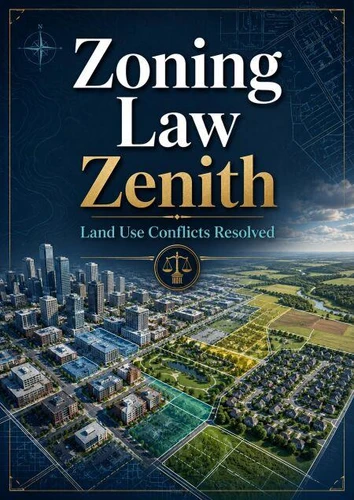
Zoning Law Zenith: Land Use Conflicts Resolved
Par :Formats :
Disponible dans votre compte client Decitre ou Furet du Nord dès validation de votre commande. Le format ePub est :
- Compatible avec une lecture sur My Vivlio (smartphone, tablette, ordinateur)
- Compatible avec une lecture sur liseuses Vivlio
- Pour les liseuses autres que Vivlio, vous devez utiliser le logiciel Adobe Digital Edition. Non compatible avec la lecture sur les liseuses Kindle, Remarkable et Sony
 , qui est-ce ?
Notre partenaire de plateforme de lecture numérique où vous retrouverez l'ensemble de vos ebooks gratuitement
Pour en savoir plus sur nos ebooks, consultez notre aide en ligne ici
C'est si simple ! Lisez votre ebook avec l'app Vivlio sur votre tablette, mobile ou ordinateur :

- FormatePub
- ISBN8235971172
- EAN9798235971172
- Date de parution31/05/2026
- Protection num.pas de protection
- Infos supplémentairesepub
- ÉditeurIoakim Ioakim
Résumé
Zoning Law Zenith: Land Use Conflicts Resolved is a comprehensive and insightful exploration of the laws, principles, conflicts, and public choices that shape the use of land in modern society. Land is never merely empty space. It is the foundation of homes, businesses, industries, farms, parks, roads, schools, sacred places, historic districts, and natural systems. Every decision about land use affects not only the owner of a parcel, but also neighbors, communities, future generations, and the environment.
This book examines how zoning law brings order to these competing claims and transforms conflict into structured governance. The book begins by explaining the foundations of zoning law, showing how public regulation developed as a necessary response to disorderly growth, incompatible land uses, overcrowding, industrial nuisance, environmental harm, and urban expansion. It carefully studies the balance between private property rights and public welfare, revealing that ownership is deeply respected in law, yet never completely free from responsibility.
Through zoning, governments seek to protect health, safety, comfort, economic stability, environmental quality, and community character. Across its chapters, the book explores the major areas of zoning practice. Residential zoning is examined as a protector of neighborhood peace, while also being questioned for its role in exclusion and housing scarcity. Commercial zoning is presented as a tool for economic growth, business access, and public convenience, but also as a source of disputes over traffic, signs, lighting, noise, and neighborhood compatibility.
Industrial zoning is discussed through the lens of employment, production, pollution, buffers, environmental justice, and public health. Agricultural zoning is treated as a guardian of farmland, rural culture, food security, soil, and open landscapes. The book also moves into modern zoning challenges. Mixed-use zoning is presented as a response to rigid separation, creating walkable and lively communities where homes, shops, offices, and public spaces may coexist.
Variances, exceptions, and special permits are explained as instruments of flexibility that allow fairness in unusual cases. Zoning boards and administrative bodies are studied as the living machinery of land use decision-making, where hearings, evidence, public participation, and reasoned judgment determine real outcomes. Important constitutional limits are also discussed, including due process, equal protection, religious freedom, speech, takings, and protection against arbitrary regulation.
The book gives special attention to affordable housing and exclusionary zoning, showing how land use rules can either open communities or silently close them. Historic preservation, cultural land use, environmental zoning, sustainable planning, urban redevelopment, gentrification, litigation, mediation, and future zoning reform are also thoughtfully examined. Written in a clear yet bookish style, Zoning Law Zenith is ideal for readers interested in law, urban planning, public policy, real estate, local government, environmental protection, housing justice, and community development.
It presents zoning not as a dry technical subject, but as a powerful civic instrument that decides how people live together upon limited land. At its heart, the book argues that land use conflicts cannot always be avoided, but with fairness, foresight, participation, and lawful balance, they can be wisely resolved.
This book examines how zoning law brings order to these competing claims and transforms conflict into structured governance. The book begins by explaining the foundations of zoning law, showing how public regulation developed as a necessary response to disorderly growth, incompatible land uses, overcrowding, industrial nuisance, environmental harm, and urban expansion. It carefully studies the balance between private property rights and public welfare, revealing that ownership is deeply respected in law, yet never completely free from responsibility.
Through zoning, governments seek to protect health, safety, comfort, economic stability, environmental quality, and community character. Across its chapters, the book explores the major areas of zoning practice. Residential zoning is examined as a protector of neighborhood peace, while also being questioned for its role in exclusion and housing scarcity. Commercial zoning is presented as a tool for economic growth, business access, and public convenience, but also as a source of disputes over traffic, signs, lighting, noise, and neighborhood compatibility.
Industrial zoning is discussed through the lens of employment, production, pollution, buffers, environmental justice, and public health. Agricultural zoning is treated as a guardian of farmland, rural culture, food security, soil, and open landscapes. The book also moves into modern zoning challenges. Mixed-use zoning is presented as a response to rigid separation, creating walkable and lively communities where homes, shops, offices, and public spaces may coexist.
Variances, exceptions, and special permits are explained as instruments of flexibility that allow fairness in unusual cases. Zoning boards and administrative bodies are studied as the living machinery of land use decision-making, where hearings, evidence, public participation, and reasoned judgment determine real outcomes. Important constitutional limits are also discussed, including due process, equal protection, religious freedom, speech, takings, and protection against arbitrary regulation.
The book gives special attention to affordable housing and exclusionary zoning, showing how land use rules can either open communities or silently close them. Historic preservation, cultural land use, environmental zoning, sustainable planning, urban redevelopment, gentrification, litigation, mediation, and future zoning reform are also thoughtfully examined. Written in a clear yet bookish style, Zoning Law Zenith is ideal for readers interested in law, urban planning, public policy, real estate, local government, environmental protection, housing justice, and community development.
It presents zoning not as a dry technical subject, but as a powerful civic instrument that decides how people live together upon limited land. At its heart, the book argues that land use conflicts cannot always be avoided, but with fairness, foresight, participation, and lawful balance, they can be wisely resolved.
A propos de Dilip Kumar Agrawal

2,99 €
2,99 €
2,99 €
2,99 €

2,99 €

2,99 €
2,99 €
2,99 €
2,99 €
2,99 €
2,99 €