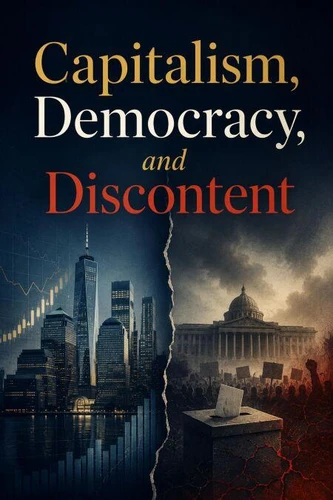
Capitalism, Democracy, and Discontent
Par :Formats :
Disponible dans votre compte client Decitre ou Furet du Nord dès validation de votre commande. Le format ePub est :
- Compatible avec une lecture sur My Vivlio (smartphone, tablette, ordinateur)
- Compatible avec une lecture sur liseuses Vivlio
- Pour les liseuses autres que Vivlio, vous devez utiliser le logiciel Adobe Digital Edition. Non compatible avec la lecture sur les liseuses Kindle, Remarkable et Sony
 , qui est-ce ?
Notre partenaire de plateforme de lecture numérique où vous retrouverez l'ensemble de vos ebooks gratuitement
Pour en savoir plus sur nos ebooks, consultez notre aide en ligne ici
C'est si simple ! Lisez votre ebook avec l'app Vivlio sur votre tablette, mobile ou ordinateur :

- FormatePub
- ISBN8235351004
- EAN9798235351004
- Date de parution24/05/2026
- Protection num.pas de protection
- Infos supplémentairesepub
- ÉditeurIoakim Ioakim
Résumé
Capitalism, Democracy, and Discontent is a thoughtful and wide-ranging exploration of the uneasy relationship between economic freedom, political equality, and public dissatisfaction in the modern world. The book examines how capitalism and democracy, two of the most powerful forces of modern history, have shaped nations, societies, institutions, and individual lives. Capitalism promises prosperity, innovation, private enterprise, competition, and material progress.
Democracy promises equality, rights, participation, public accountability, and government by the consent of the people. Yet when these two systems operate together, they often produce deep tensions that affect the lives of ordinary citizens. This book begins by tracing the historical birth of capitalist democracy, showing how markets, private property, industrial growth, political revolutions, and representative institutions developed together.
It studies the promise of prosperity that made capitalism attractive and the ideal of political equality that gave democracy its moral strength. However, it also reveals how the marketplace produces inequality, how wealth influences political power, and how money can weaken the democratic principle of equal citizenship. The book gives special attention to labor, wages, and the condition of the working citizen.
It explains how workers are politically equal as voters but often economically dependent in workplaces. It also discusses the welfare state as democracy's answer to insecurity, showing how social protection, public education, healthcare, pensions, unemployment support, and housing policies help soften the harsh effects of market life. Economic crises, recessions, debt, unemployment, inflation, and public anger are examined as moments when the moral failures of capitalism become clearly visible.
A major part of the book explores the modern sources of discontent: globalization, consumer culture, media influence, technology, automation, and the future of work. Globalization has created opportunities, but it has also displaced workers, weakened communities, and made many citizens feel that democracy has lost control over economic life. Consumer society offers choice and comfort, yet often leaves people lonely, indebted, anxious, and spiritually unfulfilled.
Media and digital platforms shape public opinion, while technology and artificial intelligence raise urgent questions about employment, privacy, inequality, and human dignity. The book also studies the rise of populism and the politics of resentment, explaining how citizens who feel ignored, humiliated, or betrayed may turn against institutions and elites. At the same time, it presents social movements as sources of democratic renewal, showing how labor movements, civil rights struggles, women's movements, environmental activism, and anti-corruption campaigns have expanded democracy beyond elections.
In its final chapters, Capitalism, Democracy, and Discontent argues for rethinking capitalism itself. It calls for fair wages, stronger labor rights, accountable corporations, progressive taxation, public investment, social protection, environmental responsibility, and democratic control over economic power. The book concludes that capitalism and democracy can coexist only when markets serve human dignity and democracy remains strong enough to govern wealth.
This book is ideal for readers interested in politics, economics, social justice, public policy, inequality, globalization, democracy, labor rights, and the moral challenges of modern society.
Democracy promises equality, rights, participation, public accountability, and government by the consent of the people. Yet when these two systems operate together, they often produce deep tensions that affect the lives of ordinary citizens. This book begins by tracing the historical birth of capitalist democracy, showing how markets, private property, industrial growth, political revolutions, and representative institutions developed together.
It studies the promise of prosperity that made capitalism attractive and the ideal of political equality that gave democracy its moral strength. However, it also reveals how the marketplace produces inequality, how wealth influences political power, and how money can weaken the democratic principle of equal citizenship. The book gives special attention to labor, wages, and the condition of the working citizen.
It explains how workers are politically equal as voters but often economically dependent in workplaces. It also discusses the welfare state as democracy's answer to insecurity, showing how social protection, public education, healthcare, pensions, unemployment support, and housing policies help soften the harsh effects of market life. Economic crises, recessions, debt, unemployment, inflation, and public anger are examined as moments when the moral failures of capitalism become clearly visible.
A major part of the book explores the modern sources of discontent: globalization, consumer culture, media influence, technology, automation, and the future of work. Globalization has created opportunities, but it has also displaced workers, weakened communities, and made many citizens feel that democracy has lost control over economic life. Consumer society offers choice and comfort, yet often leaves people lonely, indebted, anxious, and spiritually unfulfilled.
Media and digital platforms shape public opinion, while technology and artificial intelligence raise urgent questions about employment, privacy, inequality, and human dignity. The book also studies the rise of populism and the politics of resentment, explaining how citizens who feel ignored, humiliated, or betrayed may turn against institutions and elites. At the same time, it presents social movements as sources of democratic renewal, showing how labor movements, civil rights struggles, women's movements, environmental activism, and anti-corruption campaigns have expanded democracy beyond elections.
In its final chapters, Capitalism, Democracy, and Discontent argues for rethinking capitalism itself. It calls for fair wages, stronger labor rights, accountable corporations, progressive taxation, public investment, social protection, environmental responsibility, and democratic control over economic power. The book concludes that capitalism and democracy can coexist only when markets serve human dignity and democracy remains strong enough to govern wealth.
This book is ideal for readers interested in politics, economics, social justice, public policy, inequality, globalization, democracy, labor rights, and the moral challenges of modern society.
A propos de Dilip Kumar Agrawal



2,99 €

2,99 €

2,99 €

2,99 €

2,99 €



2,99 €

2,99 €

2,99 €

2,99 €
2,99 €



2,99 €