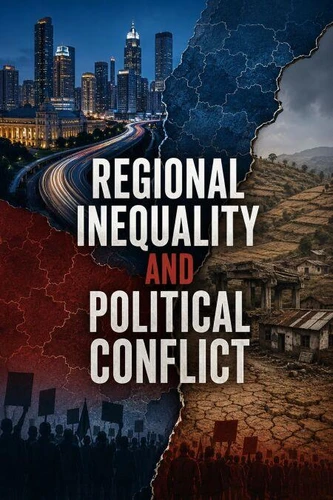
Regional Inequality and Political Conflict
Par :Formats :
Disponible dans votre compte client Decitre ou Furet du Nord dès validation de votre commande. Le format ePub est :
- Compatible avec une lecture sur My Vivlio (smartphone, tablette, ordinateur)
- Compatible avec une lecture sur liseuses Vivlio
- Pour les liseuses autres que Vivlio, vous devez utiliser le logiciel Adobe Digital Edition. Non compatible avec la lecture sur les liseuses Kindle, Remarkable et Sony
 , qui est-ce ?
Notre partenaire de plateforme de lecture numérique où vous retrouverez l'ensemble de vos ebooks gratuitement
Pour en savoir plus sur nos ebooks, consultez notre aide en ligne ici
C'est si simple ! Lisez votre ebook avec l'app Vivlio sur votre tablette, mobile ou ordinateur :

- FormatePub
- ISBN8235830707
- EAN9798235830707
- Date de parution24/05/2026
- Protection num.pas de protection
- Infos supplémentairesepub
- ÉditeurIoakim Ioakim
Résumé
Regional Inequality and Political Conflict is a thoughtful and wide-ranging study of how uneven development among regions becomes a powerful source of political dissatisfaction, social unrest, identity-based mobilization, and national instability. The book examines the deep connection between territorial inequality and political conflict, showing that regional disparity is not merely an economic issue but a question of justice, dignity, representation, and belonging.
Every nation contains regions that grow at different speeds. Some regions enjoy industries, universities, hospitals, highways, digital networks, public investment, and political influence, while others remain marked by poverty, unemployment, weak infrastructure, poor education, fragile health systems, and administrative neglect. This book explains how such differences, when left unresolved, create resentment among people who feel that their homeland has been ignored or exploited.
It argues that political conflict often begins when citizens believe that their region has been denied its fair share of development, resources, and respect. The book begins by explaining the meaning, nature, and scope of regional inequality. It explores the historical roots of uneven development, including colonial legacies, unequal trade routes, administrative centralization, and resource extraction.
It then examines the role of geography, natural resources, agriculture, industrialization, infrastructure, education, health, employment, and migration in shaping regional disparities. Each chapter shows how economic backwardness can gradually become a political grievance when people compare their region with more prosperous areas. A major strength of the book is its attention to identity. It explains how regional inequality becomes more intense when it is linked with language, ethnicity, culture, religion, tribal identity, or historical memory.
A neglected region may not only demand roads and jobs; it may also demand recognition, dignity, autonomy, and respect for its identity. The book carefully discusses regional parties, protest movements, insurgency, separatism, federalism, decentralization, and resource-sharing disputes as political responses to unequal development. The later chapters focus on solutions. The book argues that regional inequality cannot be solved by temporary promises or symbolic announcements.
It requires balanced regional planning, fair fiscal policies, targeted investment, accountable governance, inclusive infrastructure, quality education, accessible health care, employment generation, local participation, and respect for cultural diversity. It also explains how globalization, technology, markets, and climate change are creating new regional divides, making regional justice even more urgent in the modern world.
Written in a clear and bookish style, Regional Inequality and Political Conflict is suitable for readers interested in political economy, development studies, public policy, regional planning, conflict studies, governance, federalism, and social justice. It provides a comprehensive understanding of why some regions become centers of prosperity while others become spaces of grievance. At its heart, this book offers a powerful message: a nation cannot remain truly peaceful if large parts of its territory feel forgotten.
Lasting unity requires more than borders and laws; it requires fairness among regions. Regional justice is therefore not only a development goal but also the foundation of democracy, stability, and political harmony.
Every nation contains regions that grow at different speeds. Some regions enjoy industries, universities, hospitals, highways, digital networks, public investment, and political influence, while others remain marked by poverty, unemployment, weak infrastructure, poor education, fragile health systems, and administrative neglect. This book explains how such differences, when left unresolved, create resentment among people who feel that their homeland has been ignored or exploited.
It argues that political conflict often begins when citizens believe that their region has been denied its fair share of development, resources, and respect. The book begins by explaining the meaning, nature, and scope of regional inequality. It explores the historical roots of uneven development, including colonial legacies, unequal trade routes, administrative centralization, and resource extraction.
It then examines the role of geography, natural resources, agriculture, industrialization, infrastructure, education, health, employment, and migration in shaping regional disparities. Each chapter shows how economic backwardness can gradually become a political grievance when people compare their region with more prosperous areas. A major strength of the book is its attention to identity. It explains how regional inequality becomes more intense when it is linked with language, ethnicity, culture, religion, tribal identity, or historical memory.
A neglected region may not only demand roads and jobs; it may also demand recognition, dignity, autonomy, and respect for its identity. The book carefully discusses regional parties, protest movements, insurgency, separatism, federalism, decentralization, and resource-sharing disputes as political responses to unequal development. The later chapters focus on solutions. The book argues that regional inequality cannot be solved by temporary promises or symbolic announcements.
It requires balanced regional planning, fair fiscal policies, targeted investment, accountable governance, inclusive infrastructure, quality education, accessible health care, employment generation, local participation, and respect for cultural diversity. It also explains how globalization, technology, markets, and climate change are creating new regional divides, making regional justice even more urgent in the modern world.
Written in a clear and bookish style, Regional Inequality and Political Conflict is suitable for readers interested in political economy, development studies, public policy, regional planning, conflict studies, governance, federalism, and social justice. It provides a comprehensive understanding of why some regions become centers of prosperity while others become spaces of grievance. At its heart, this book offers a powerful message: a nation cannot remain truly peaceful if large parts of its territory feel forgotten.
Lasting unity requires more than borders and laws; it requires fairness among regions. Regional justice is therefore not only a development goal but also the foundation of democracy, stability, and political harmony.
A propos de Dilip Kumar Agrawal



2,99 €
2,99 €

2,99 €
2,99 €

2,99 €



2,99 €

2,99 €

2,99 €
2,99 €
2,99 €



2,99 €