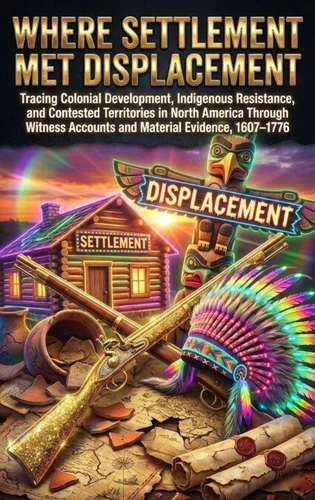
Where Settlement Met Displacement. Tracing Colonial Development, Indigenous Resistance, and Contested Territories in North America Through Witness Accounts and Material Evidence, 1607–1776
Par :Formats :
Disponible dans votre compte client Decitre ou Furet du Nord dès validation de votre commande. Le format ePub est :
- Compatible avec une lecture sur My Vivlio (smartphone, tablette, ordinateur)
- Compatible avec une lecture sur liseuses Vivlio
- Pour les liseuses autres que Vivlio, vous devez utiliser le logiciel Adobe Digital Edition. Non compatible avec la lecture sur les liseuses Kindle, Remarkable et Sony
 , qui est-ce ?
Notre partenaire de plateforme de lecture numérique où vous retrouverez l'ensemble de vos ebooks gratuitement
Pour en savoir plus sur nos ebooks, consultez notre aide en ligne ici
C'est si simple ! Lisez votre ebook avec l'app Vivlio sur votre tablette, mobile ou ordinateur :

- Nombre de pages182
- FormatePub
- ISBN978-3-565-19882-5
- EAN9783565198825
- Date de parution27/01/2026
- Protection num.pas de protection
- Taille2 Mo
- Infos supplémentairesepub
- ÉditeurEmphaloz Publishing House
Résumé
Colonial America was not built on empty land awaiting European civilization, but carved from territories with established communities, trade networks, and diplomatic systems that had existed for centuries. Every settlement negotiation masked coercion, every land deed concealed prior claims, and every boundary line represented erasure of Indigenous sovereignty.
This book examines colonial development through the voices often excluded from founding narratives: Indigenous leaders navigating impossible choices between resistance and accommodation, enslaved Africans whose forced labor made plantation economies viable, indentured servants whose dreams of land ownership collided with elite consolidation of property, and women whose domestic labor sustained settlements while legal systems denied them autonomy.
It traces how early cooperation deteriorated into systematic displacement, how disease and violence created demographic collapse, and how colonial legal frameworks legitimized theft through manufactured justifications. Drawing on treaty negotiations, court records, archaeological evidence from contact sites, oral histories preserved in tribal archives, and material culture revealing daily interactions, it explores how different European powers pursued distinct colonial strategies, how Indigenous nations formed alliances to resist encroachment, how enslaved communities built networks of survival and resistance, and how ecological transformation followed European agricultural practices.
It examines how conflicts over land, resources, and sovereignty escalated into wars that devastated entire regions. This is a reckoning with how colonial institutions-plantations, missions, trading posts, military forts-created structures of inequality that persisted long after independence.
It traces how early cooperation deteriorated into systematic displacement, how disease and violence created demographic collapse, and how colonial legal frameworks legitimized theft through manufactured justifications. Drawing on treaty negotiations, court records, archaeological evidence from contact sites, oral histories preserved in tribal archives, and material culture revealing daily interactions, it explores how different European powers pursued distinct colonial strategies, how Indigenous nations formed alliances to resist encroachment, how enslaved communities built networks of survival and resistance, and how ecological transformation followed European agricultural practices.
It examines how conflicts over land, resources, and sovereignty escalated into wars that devastated entire regions. This is a reckoning with how colonial institutions-plantations, missions, trading posts, military forts-created structures of inequality that persisted long after independence.
A propos de Thalia Brookstone















8,99 €