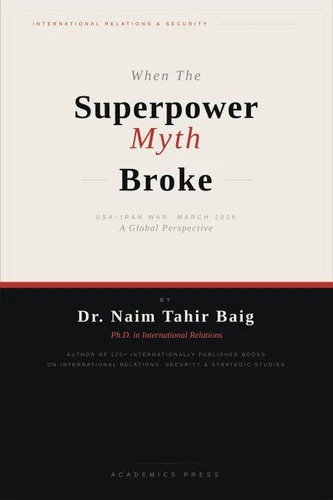
BOOK DESCRIPTIONWhen the Superpower Myth Broke: The USA-Iran War, March 2026 - A Global PerspectiveBy Dr. Naim Tahir Baig, Ph. D. On February 28, 2026, the United States and Israel launched Operation Epic Fury-a coordinated, multi-theatre military campaign that assassinated Iran's Supreme Leader Ali Khamenei, struck cities from Tehran to Isfahan, and ignited the most consequential geopolitical crisis of the twenty-first century.
Within hours, Iran retaliated with over eight hundred drones and nearly four hundred missiles targeting installations across twelve nations. Within days, the Strait of Hormuz-the passage through which one-fifth of the world's oil flows-was effectively closed. Within weeks, the superpower that had spent decades projecting unchallengeable dominance found itself at war with no exit, no consensus, and no precedent.
When the Superpower Myth Broke is the first comprehensive, rigorously documented account of the 2026 Iran War and its profound, still-unfolding consequences for the international order. Drawing on verified open-source intelligence, legal scholarship, humanitarian data, and strategic analysis, Dr. Naim Tahir Baig constructs a forensic and panoramic narrative-from the origins of American exceptionalism to the moment a fifty-thousand-dollar drone shut down the world's most critical energy chokepoint.
This is not merely a book about a war. It is a book about the architecture of power, the fragility of myths, and the moment the world stopped believing. Across twelve densely argued chapters, the book traces how decades of unchallenged military supremacy bred a dangerous strategic overconfidence-one that led Washington to launch a war without congressional authorization, without United Nations approval, and, according to its own Pentagon briefers, without evidence that Iran was planning to strike first.
It examines Iran's defiant retaliation and its sophisticated asymmetric strategy: closing an ocean artery not with a fleet but with drones and GPS jamming. It interrogates the fractured response of America's allies, the calculated positioning of China and Russia, and the moral outcry of a Global South that had long understood what the "rules-based order" actually protected. And it confronts the human cost with unflinching clarity-the 165 schoolgirls killed in Minab, the 330, 000 displaced, the health infrastructure methodically dismantled, and the information blackout designed to keep the dying invisible.
Written from a distinctly international perspective-and with the analytical frankness that only comes from intellectual independence-this book does not treat the war as an American story seen from Washington. It treats it as a world event seen from everywhere at once: from the Gulf states bombed for hosting foreign bases, from Pakistan where twenty-six protesters died in the streets, from Norway where a US Embassy was attacked, from the Iranian women's soccer team who sought asylum in Australia rather than return to a nation at war.
The book is equally unflinching in its legal analysis-cataloguing violations of the UN Charter, the Rome Statute, International Humanitarian Law, and the US Constitution itself-and in its economic reckoning, documenting how Brent crude surged seventy percent in ten days and how the world's most vulnerable nations bore the heaviest burden of a war they had no voice in starting. When the Superpower Myth Broke is essential reading for scholars of international relations, strategic studies, and Middle Eastern politics; for practitioners of international law and humanitarian policy; for journalists, diplomats, and policymakers navigating a world in which the old certainties no longer hold; and for every citizen of every country who watched, in real time, the foundations of a seventy-year international order begin to crack.
BOOK DESCRIPTIONWhen the Superpower Myth Broke: The USA-Iran War, March 2026 - A Global PerspectiveBy Dr. Naim Tahir Baig, Ph. D. On February 28, 2026, the United States and Israel launched Operation Epic Fury-a coordinated, multi-theatre military campaign that assassinated Iran's Supreme Leader Ali Khamenei, struck cities from Tehran to Isfahan, and ignited the most consequential geopolitical crisis of the twenty-first century.
Within hours, Iran retaliated with over eight hundred drones and nearly four hundred missiles targeting installations across twelve nations. Within days, the Strait of Hormuz-the passage through which one-fifth of the world's oil flows-was effectively closed. Within weeks, the superpower that had spent decades projecting unchallengeable dominance found itself at war with no exit, no consensus, and no precedent.
When the Superpower Myth Broke is the first comprehensive, rigorously documented account of the 2026 Iran War and its profound, still-unfolding consequences for the international order. Drawing on verified open-source intelligence, legal scholarship, humanitarian data, and strategic analysis, Dr. Naim Tahir Baig constructs a forensic and panoramic narrative-from the origins of American exceptionalism to the moment a fifty-thousand-dollar drone shut down the world's most critical energy chokepoint.
This is not merely a book about a war. It is a book about the architecture of power, the fragility of myths, and the moment the world stopped believing. Across twelve densely argued chapters, the book traces how decades of unchallenged military supremacy bred a dangerous strategic overconfidence-one that led Washington to launch a war without congressional authorization, without United Nations approval, and, according to its own Pentagon briefers, without evidence that Iran was planning to strike first.
It examines Iran's defiant retaliation and its sophisticated asymmetric strategy: closing an ocean artery not with a fleet but with drones and GPS jamming. It interrogates the fractured response of America's allies, the calculated positioning of China and Russia, and the moral outcry of a Global South that had long understood what the "rules-based order" actually protected. And it confronts the human cost with unflinching clarity-the 165 schoolgirls killed in Minab, the 330, 000 displaced, the health infrastructure methodically dismantled, and the information blackout designed to keep the dying invisible.
Written from a distinctly international perspective-and with the analytical frankness that only comes from intellectual independence-this book does not treat the war as an American story seen from Washington. It treats it as a world event seen from everywhere at once: from the Gulf states bombed for hosting foreign bases, from Pakistan where twenty-six protesters died in the streets, from Norway where a US Embassy was attacked, from the Iranian women's soccer team who sought asylum in Australia rather than return to a nation at war.
The book is equally unflinching in its legal analysis-cataloguing violations of the UN Charter, the Rome Statute, International Humanitarian Law, and the US Constitution itself-and in its economic reckoning, documenting how Brent crude surged seventy percent in ten days and how the world's most vulnerable nations bore the heaviest burden of a war they had no voice in starting. When the Superpower Myth Broke is essential reading for scholars of international relations, strategic studies, and Middle Eastern politics; for practitioners of international law and humanitarian policy; for journalists, diplomats, and policymakers navigating a world in which the old certainties no longer hold; and for every citizen of every country who watched, in real time, the foundations of a seventy-year international order begin to crack.

 , qui est-ce ?