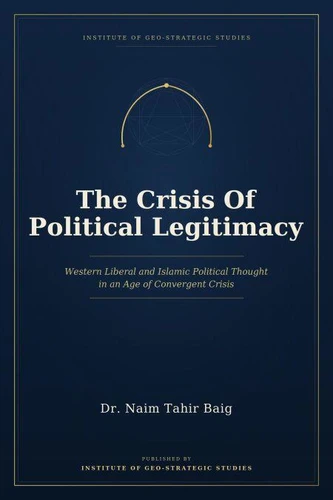
The Crisis of Political Legitimacy: Western Liberal and Islamic Political Thought in an Age of Convergent CrisisDr. Naim Tahir BaigWe are accustomed to thinking of the Western liberal and Islamic political traditions as adversaries locked in a contest of incompatible values - a clash of civilizations whose outcome will shape the century. The Crisis of Political Legitimacyargues that this familiar picture mistakes a symptom for a cause.
The two traditions are not, at the deepest level, enemies. They are fellow sufferers of a single affliction: each has lost confidence in its own account of what makes the exercise of power rightful rather than merely effective. What looks like confrontation is the friction of two traditions that find it easier to define themselves against an external adversary than to confront the vacancy at their own foundations.
Drawing on the most recent evidence of democratic backsliding across Europe and North America and the documented collapse of theocratic legitimacy in Iran, Dr. Naim Tahir Baig shows that these are not separate crises with separate causes. They are parallel instantiations of a structural problem both traditions inherited from their classical sources and never fully resolved - what the book calls the grounding problem: the inability of modern political authority to ground sovereignty in anything beyond itself.
Western liberal democracy grounds authority in the will of the governed but cannot explain, without circularity, why that will should be authoritative. The dominant modern Islamic answer grounds authority in divine sovereignty but cannot specify, without a theory of interpretation it has never fully worked out, whose understanding of the divine will is authoritative in a pluralistic modern state. Against both the clash-of-civilizations thesis and the decline narrative, the book insists that neither "the West" nor "Islam" is a civilizational bloc with a settled view of legitimacy.
Each is internally plural, historically contested, and normatively unresolved - and that plurality is not a defect but the evidence of living traditions capable of self-critique. From this insight the book draws its central and most ambitious move: read carefully from within, each tradition contains conceptual resources the other has overlooked. The Islamic practice of consultative authority, the historical distinction between political and legal authority, and the juristic concept of public interest offer resources for thinking about legitimacy after liberal proceduralism; the Western natural-law tradition, with its shared Aristotelian and Avicennian foundations, offers resources for Islamic legal reform that require no secularizing assimilation.
Rigorous in method and candid about its own standpoint, The Crisis of Political Legitimacy is a work of comparative political theory written after Orientalism - one that treats untranslatability as an analytical resource rather than an obstacle, and that submits its readings of Islamic sources to the scrutiny of the tradition's own scholars. It will be essential reading for political theorists, scholars of Islamic and Western political thought, and any reader who senses that the legitimacy crisis is real and wants something more demanding than apologetics or alarm.
The reader who finishes this book will not be handed a formula for legitimate authority. They will be given something more useful: a precise map of where the genuine alternatives lie, where the real resources for reconstruction are buried, and why that reconstruction is at once possible and urgent.
The Crisis of Political Legitimacy: Western Liberal and Islamic Political Thought in an Age of Convergent CrisisDr. Naim Tahir BaigWe are accustomed to thinking of the Western liberal and Islamic political traditions as adversaries locked in a contest of incompatible values - a clash of civilizations whose outcome will shape the century. The Crisis of Political Legitimacyargues that this familiar picture mistakes a symptom for a cause.
The two traditions are not, at the deepest level, enemies. They are fellow sufferers of a single affliction: each has lost confidence in its own account of what makes the exercise of power rightful rather than merely effective. What looks like confrontation is the friction of two traditions that find it easier to define themselves against an external adversary than to confront the vacancy at their own foundations.
Drawing on the most recent evidence of democratic backsliding across Europe and North America and the documented collapse of theocratic legitimacy in Iran, Dr. Naim Tahir Baig shows that these are not separate crises with separate causes. They are parallel instantiations of a structural problem both traditions inherited from their classical sources and never fully resolved - what the book calls the grounding problem: the inability of modern political authority to ground sovereignty in anything beyond itself.
Western liberal democracy grounds authority in the will of the governed but cannot explain, without circularity, why that will should be authoritative. The dominant modern Islamic answer grounds authority in divine sovereignty but cannot specify, without a theory of interpretation it has never fully worked out, whose understanding of the divine will is authoritative in a pluralistic modern state. Against both the clash-of-civilizations thesis and the decline narrative, the book insists that neither "the West" nor "Islam" is a civilizational bloc with a settled view of legitimacy.
Each is internally plural, historically contested, and normatively unresolved - and that plurality is not a defect but the evidence of living traditions capable of self-critique. From this insight the book draws its central and most ambitious move: read carefully from within, each tradition contains conceptual resources the other has overlooked. The Islamic practice of consultative authority, the historical distinction between political and legal authority, and the juristic concept of public interest offer resources for thinking about legitimacy after liberal proceduralism; the Western natural-law tradition, with its shared Aristotelian and Avicennian foundations, offers resources for Islamic legal reform that require no secularizing assimilation.
Rigorous in method and candid about its own standpoint, The Crisis of Political Legitimacy is a work of comparative political theory written after Orientalism - one that treats untranslatability as an analytical resource rather than an obstacle, and that submits its readings of Islamic sources to the scrutiny of the tradition's own scholars. It will be essential reading for political theorists, scholars of Islamic and Western political thought, and any reader who senses that the legitimacy crisis is real and wants something more demanding than apologetics or alarm.
The reader who finishes this book will not be handed a formula for legitimate authority. They will be given something more useful: a precise map of where the genuine alternatives lie, where the real resources for reconstruction are buried, and why that reconstruction is at once possible and urgent.

 , qui est-ce ?