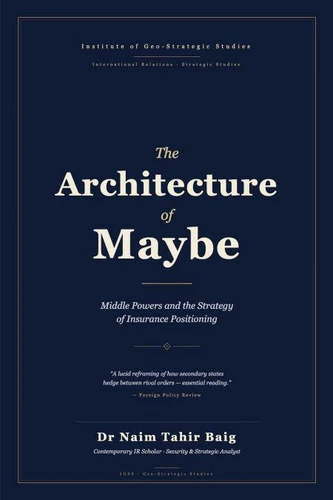
Book DescriptionThe Architecture of MaybeInsurance Positioning and the Middle-Power Equilibrium of the Twenty-First CenturyDr Naim Tahir BaigAbout the BookIn the second half of the 2020s, a striking pattern has emerged across the international system. Six structurally dissimilar states - South Korea, Turkey, Saudi Arabia, the United Arab Emirates, Vietnam, and Poland - have converged on the same foreign-policy playbook in the same five-year window.
None of them coordinated. None of them share regime type, region, capability tier, or ideological framework. And yet all of them are doing the same thing: building deliberate, asymmetric portfolios that distribute security commitments toward one superpower and economic commitments toward the other, sustained through bureaucratic continuity or carefully constructed national-identity narratives, and managed across leadership transitions through institutional rather than personal mechanisms.
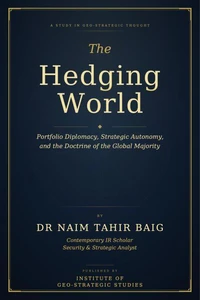
Drawing on contemporary international relations theory, country-level empirical research across three regions, and original primary-source analysis through May 2026, Dr Naim Tahir Baig argues that what the academic literature has called hedging and what diplomats have more privately called insurance has matured, in this period, into a structurally rational equilibrium strategy that the dominant predictions of structural realism did not anticipate.
The book introduces the concept of insurance positioning - a refinement and extension of Cheng-Chwee Kuik's small-state hedging framework - specified through four formal elements: domain separation, asymmetric depth, bounded transgression, and capacity investment at the seam. Each element is given observable indicators, falsification conditions, and operational thresholds. The framework is then tested across the six primary cases, against three negative cases (Indonesia, Brazil, and South Africa) that face the structural condition but lack the requisite state capacity, and through a formal falsification test on India that predicts its emerging trajectory toward full membership in the class.
The book's central diagnosis is structural. The international system in the 2020s is characterized by a bipolar core nested within a multipolar periphery - a configuration in which two superpowers dominate compute, finance, naval reach, and formal security architecture, while regional powers retain genuine but bounded agency. Neither superpower can supply, alone, the full bundle that a substantial middle power requires.
The rational response to this condition is not binary alignment, as the dominant "forced to choose" literature has predicted, but the deliberate construction of asymmetric portfolios that exploit the seam between the two great powers' domains of monopoly. What follows is a careful empirical reconstruction of how six different states are doing this. The South Korea chapter examines Seoul's pioneering bifurcated strategy, the THAAD episode, and the resilience of the architecture through the Yoon martial-law crisis.
The Turkey chapter analyzes the S-400 episode as the canonical case of calibrated transgression and offers an explicit specification of what makes a transgression calibrated rather than reckless. The Saudi Arabia and UAE chapter compares two operationally distinct Gulf variants of the same underlying logic. The Vietnam chapter treats bamboo diplomacy as the minimum-viable expression of insurance positioning.
The Poland chapter shows how the strategy generalizes to an EU/NATO frontline state where the relevant competition is not US-China but US-Brussels. The five comparative chapters synthesize a common playbook across the six cases.
Book DescriptionThe Architecture of MaybeInsurance Positioning and the Middle-Power Equilibrium of the Twenty-First CenturyDr Naim Tahir BaigAbout the BookIn the second half of the 2020s, a striking pattern has emerged across the international system. Six structurally dissimilar states - South Korea, Turkey, Saudi Arabia, the United Arab Emirates, Vietnam, and Poland - have converged on the same foreign-policy playbook in the same five-year window.
None of them coordinated. None of them share regime type, region, capability tier, or ideological framework. And yet all of them are doing the same thing: building deliberate, asymmetric portfolios that distribute security commitments toward one superpower and economic commitments toward the other, sustained through bureaucratic continuity or carefully constructed national-identity narratives, and managed across leadership transitions through institutional rather than personal mechanisms.
Drawing on contemporary international relations theory, country-level empirical research across three regions, and original primary-source analysis through May 2026, Dr Naim Tahir Baig argues that what the academic literature has called hedging and what diplomats have more privately called insurance has matured, in this period, into a structurally rational equilibrium strategy that the dominant predictions of structural realism did not anticipate.
The book introduces the concept of insurance positioning - a refinement and extension of Cheng-Chwee Kuik's small-state hedging framework - specified through four formal elements: domain separation, asymmetric depth, bounded transgression, and capacity investment at the seam. Each element is given observable indicators, falsification conditions, and operational thresholds. The framework is then tested across the six primary cases, against three negative cases (Indonesia, Brazil, and South Africa) that face the structural condition but lack the requisite state capacity, and through a formal falsification test on India that predicts its emerging trajectory toward full membership in the class.
The book's central diagnosis is structural. The international system in the 2020s is characterized by a bipolar core nested within a multipolar periphery - a configuration in which two superpowers dominate compute, finance, naval reach, and formal security architecture, while regional powers retain genuine but bounded agency. Neither superpower can supply, alone, the full bundle that a substantial middle power requires.
The rational response to this condition is not binary alignment, as the dominant "forced to choose" literature has predicted, but the deliberate construction of asymmetric portfolios that exploit the seam between the two great powers' domains of monopoly. What follows is a careful empirical reconstruction of how six different states are doing this. The South Korea chapter examines Seoul's pioneering bifurcated strategy, the THAAD episode, and the resilience of the architecture through the Yoon martial-law crisis.
The Turkey chapter analyzes the S-400 episode as the canonical case of calibrated transgression and offers an explicit specification of what makes a transgression calibrated rather than reckless. The Saudi Arabia and UAE chapter compares two operationally distinct Gulf variants of the same underlying logic. The Vietnam chapter treats bamboo diplomacy as the minimum-viable expression of insurance positioning.
The Poland chapter shows how the strategy generalizes to an EU/NATO frontline state where the relevant competition is not US-China but US-Brussels. The five comparative chapters synthesize a common playbook across the six cases.