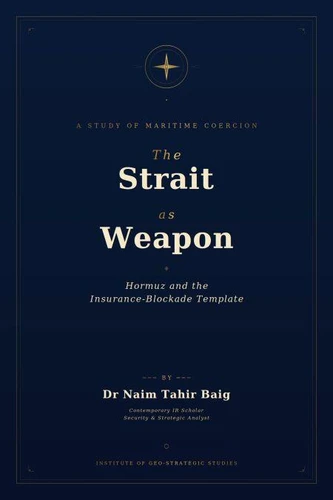
BOOK DESCRIPTIONThe Strait as Weapon: Hormuz and the Insurance-Blockade TemplateBy Dr Naim Tahir BaigIn February-March 2026, the Islamic Republic of Iran did something that no analytical framework in maritime strategic studies had adequately anticipated. Following the opening strikes of Operation Epic Fury - the coordinated United States and Israeli military campaign that killed Supreme Leader Ali Khamenei in the first wave - Tehran's response was not the conventional naval engagement that four decades of Pentagon planning had prepared for.
It was, instead, a calibrated combination of VHF broadcasts, selective drone strikes, and a formal declaration of "protective transit control" that delegated the enforcement of its blockade to a target the United States Fifth Fleet could not reach: the war-risk underwriting desks of the Lloyd's marine insurance market in London. Within seventy-two hours, the Strait of Hormuz - through which twenty percent of global seaborne oil moves - was commercially closed without a single mine in the water.
By 5 March, war-risk cover had been withdrawn entirely. Approximately 3, 200 vessels lay stranded outside Fujairah. LNG transits fell to zero for the first time in the strait's recorded history. The Strait as Weapon is the long-form analytical companion to Dr Naim Tahir Baig's peer-reviewed paper Chokepoint as Weapon (Journal of International Security Studies, 2026), the framing of which was adopted by Riviera Maritime Media on 10 April 2026 under the headline "is not an aberration - it is a template." Across twelve chapters, the book reconstructs the crisis in forensic detail and develops the theoretical apparatus required to understand it: a five-layer model of the strait (physical, economic, political, legal, informational), a four-phase escalation sequence (VHF warnings, kinetic strikes, insurance cascade, formal declaration), and a new concept of insurance-blockade coercion that the book argues will become the dominant mode of chokepoint warfare in the decade ahead.
The argument the book advances is sharp. The dominant frameworks for understanding maritime power - from Mahan's command of the sea through Corbett's graduated sea control to Posen's command of the commons - were developed for a world in which decisive force resided in hulls and missiles. The 2026 crisis revealed a world in which decisive power had migrated to contracts, actuarial models, and a committee of underwriters convening in the Lloyd's building on Lime Street.
Naval supremacy remains necessary; it is no longer sufficient. The book traces the implications of that shift through international law (Chapter 9), energy and macroeconomic markets (Chapter 8), the diplomatic recalibration of four capitals (Chapter 10), and a comparative analysis of five further chokepoints - Bab el-Mandeb, Malacca, the Bosporus, Suez, and Panama - to establish where the Hormuz template travels and where it does not (Chapter 11).
The book closes with a structured futures chapter (Chapter 12) containing three scenarios, an eleven-indicator basket for real-time tracking of which trajectory is operative, and a set of numbered policy recommendations addressed to identifiable actors. For scholars of international relations and strategic studies, The Strait as Weapon offers a new theoretical apparatus for analysing sub-threshold coercion in an era of globalised maritime finance.
For policymakers in the United States, the United Kingdom, the European Union, the Gulf Cooperation Council, India, Pakistan, and China, it offers a diagnostic framework and a concrete set of resilience measures. The chokepoint, the book argues, is no longer a place. It is a system. Understanding the 2026 crisis is the first step to defending all of them.
BOOK DESCRIPTIONThe Strait as Weapon: Hormuz and the Insurance-Blockade TemplateBy Dr Naim Tahir BaigIn February-March 2026, the Islamic Republic of Iran did something that no analytical framework in maritime strategic studies had adequately anticipated. Following the opening strikes of Operation Epic Fury - the coordinated United States and Israeli military campaign that killed Supreme Leader Ali Khamenei in the first wave - Tehran's response was not the conventional naval engagement that four decades of Pentagon planning had prepared for.
It was, instead, a calibrated combination of VHF broadcasts, selective drone strikes, and a formal declaration of "protective transit control" that delegated the enforcement of its blockade to a target the United States Fifth Fleet could not reach: the war-risk underwriting desks of the Lloyd's marine insurance market in London. Within seventy-two hours, the Strait of Hormuz - through which twenty percent of global seaborne oil moves - was commercially closed without a single mine in the water.
By 5 March, war-risk cover had been withdrawn entirely. Approximately 3, 200 vessels lay stranded outside Fujairah. LNG transits fell to zero for the first time in the strait's recorded history. The Strait as Weapon is the long-form analytical companion to Dr Naim Tahir Baig's peer-reviewed paper Chokepoint as Weapon (Journal of International Security Studies, 2026), the framing of which was adopted by Riviera Maritime Media on 10 April 2026 under the headline "is not an aberration - it is a template." Across twelve chapters, the book reconstructs the crisis in forensic detail and develops the theoretical apparatus required to understand it: a five-layer model of the strait (physical, economic, political, legal, informational), a four-phase escalation sequence (VHF warnings, kinetic strikes, insurance cascade, formal declaration), and a new concept of insurance-blockade coercion that the book argues will become the dominant mode of chokepoint warfare in the decade ahead.
The argument the book advances is sharp. The dominant frameworks for understanding maritime power - from Mahan's command of the sea through Corbett's graduated sea control to Posen's command of the commons - were developed for a world in which decisive force resided in hulls and missiles. The 2026 crisis revealed a world in which decisive power had migrated to contracts, actuarial models, and a committee of underwriters convening in the Lloyd's building on Lime Street.
Naval supremacy remains necessary; it is no longer sufficient. The book traces the implications of that shift through international law (Chapter 9), energy and macroeconomic markets (Chapter 8), the diplomatic recalibration of four capitals (Chapter 10), and a comparative analysis of five further chokepoints - Bab el-Mandeb, Malacca, the Bosporus, Suez, and Panama - to establish where the Hormuz template travels and where it does not (Chapter 11).
The book closes with a structured futures chapter (Chapter 12) containing three scenarios, an eleven-indicator basket for real-time tracking of which trajectory is operative, and a set of numbered policy recommendations addressed to identifiable actors. For scholars of international relations and strategic studies, The Strait as Weapon offers a new theoretical apparatus for analysing sub-threshold coercion in an era of globalised maritime finance.
For policymakers in the United States, the United Kingdom, the European Union, the Gulf Cooperation Council, India, Pakistan, and China, it offers a diagnostic framework and a concrete set of resilience measures. The chokepoint, the book argues, is no longer a place. It is a system. Understanding the 2026 crisis is the first step to defending all of them.