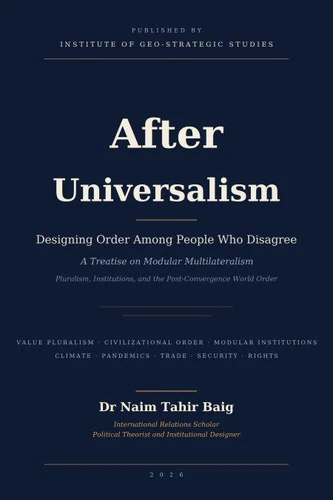
After UniversalismModular Multilateralism for a Post-Convergence WorldDr Naim Tahir BaigBook DescriptionThe convergence wager of liberal internationalism has lost. The bet placed in 1945 - that the institutions built after the war would, over time, spread democratic governance, market economics, and human rights norms until the world's major powers shared enough common values to make the postwar rules look self-evident - is now twenty years past its sell-by date.
Freedom House counts twenty consecutive years of global democratic decline. The V-Dem Institute records the first moment in more than two decades when autocracies outnumbered democracies. The Nuclear Non-Proliferation Treaty Review Conferences of 2015 and 2022 ended without agreement. The WHO Pandemic Agreement, adopted after more than three years of negotiation, could not be opened for signature because its most consequential provision had to be deferred.
The institutions of the postwar order are not weathering a passing crisis. They are failing in the specific ways that institutions designed around an assumption fail when the assumption proves false. After Universalism is the most rigorous account yet written of what to do about it. Dr. Naim Tahir Baig argues that the failure is not only empirical but structural: the universalist self-understanding of the postwar order, once a source of legitimacy and ambition, has now become a source of damage.
Imperial drift, procedural overreach, membership extended without genuine buy-in, and the corrosive practice of selective enforcement have produced a legitimacy deficit that revisionists did not create but have learned to exploit. The institutions can be defended only by being redesigned. The book offers that redesign. Across thirteen chapters and six detailed case studies - climate, pandemics, trade, human rights, security, and financial governance - Baig develops the framework he calls modular multilateralism: an architecture for cooperation organised around specific public goods rather than around comprehensive visions of world order.
Five design rules anchor the proposal. Decompose cooperation by good and sequence the decomposition. Keep shared commitments calibrated to what an honestly specified universal kernel can bear, not to what the contested agenda aspires to. Tie variable participation to verifiable indicators rather than to self-declared categories. Permit overlapping institutions, disciplined by precise scope statements rather than by exclusive membership.
Make exit cheap and re-entry conditional on demonstrated compliance with the floor. What follows from these rules is an institutional vision both more modest and more durable than the universalist inheritance it replaces. A modular WHO with five distinct modules - universal surveillance as the mandatory floor, capacity-building, manufacturing access, pathogen access and benefit-sharing, and outbreak financing - each negotiated separately and capable of operating independently.
A modular WTO architecture above the MFN floor, with critical-mass and exclusive plurilaterals adapted to specific sectors and the MPIA model extended as the template for plurilateral dispute settlement. A five-pillar rights architecture that concentrates universal enforcement on the atrocity floor while devolving contested rights to opt-in protocols and regional mechanisms. An Indo-Pacific security latticework already operating as modular architecture in practice, paired with a European NATO-plus-EU configuration that the case study reads as a working illustration rather than as an aberration.
A financial governance system the book treats as the longest-running experiment in modular cooperation, with implications for both state and non-state actors. After Universalism is the constructive proposal the present moment requires. Its argument is finished. Its work is not.
After UniversalismModular Multilateralism for a Post-Convergence WorldDr Naim Tahir BaigBook DescriptionThe convergence wager of liberal internationalism has lost. The bet placed in 1945 - that the institutions built after the war would, over time, spread democratic governance, market economics, and human rights norms until the world's major powers shared enough common values to make the postwar rules look self-evident - is now twenty years past its sell-by date.
Freedom House counts twenty consecutive years of global democratic decline. The V-Dem Institute records the first moment in more than two decades when autocracies outnumbered democracies. The Nuclear Non-Proliferation Treaty Review Conferences of 2015 and 2022 ended without agreement. The WHO Pandemic Agreement, adopted after more than three years of negotiation, could not be opened for signature because its most consequential provision had to be deferred.
The institutions of the postwar order are not weathering a passing crisis. They are failing in the specific ways that institutions designed around an assumption fail when the assumption proves false. After Universalism is the most rigorous account yet written of what to do about it. Dr. Naim Tahir Baig argues that the failure is not only empirical but structural: the universalist self-understanding of the postwar order, once a source of legitimacy and ambition, has now become a source of damage.
Imperial drift, procedural overreach, membership extended without genuine buy-in, and the corrosive practice of selective enforcement have produced a legitimacy deficit that revisionists did not create but have learned to exploit. The institutions can be defended only by being redesigned. The book offers that redesign. Across thirteen chapters and six detailed case studies - climate, pandemics, trade, human rights, security, and financial governance - Baig develops the framework he calls modular multilateralism: an architecture for cooperation organised around specific public goods rather than around comprehensive visions of world order.
Five design rules anchor the proposal. Decompose cooperation by good and sequence the decomposition. Keep shared commitments calibrated to what an honestly specified universal kernel can bear, not to what the contested agenda aspires to. Tie variable participation to verifiable indicators rather than to self-declared categories. Permit overlapping institutions, disciplined by precise scope statements rather than by exclusive membership.
Make exit cheap and re-entry conditional on demonstrated compliance with the floor. What follows from these rules is an institutional vision both more modest and more durable than the universalist inheritance it replaces. A modular WHO with five distinct modules - universal surveillance as the mandatory floor, capacity-building, manufacturing access, pathogen access and benefit-sharing, and outbreak financing - each negotiated separately and capable of operating independently.
A modular WTO architecture above the MFN floor, with critical-mass and exclusive plurilaterals adapted to specific sectors and the MPIA model extended as the template for plurilateral dispute settlement. A five-pillar rights architecture that concentrates universal enforcement on the atrocity floor while devolving contested rights to opt-in protocols and regional mechanisms. An Indo-Pacific security latticework already operating as modular architecture in practice, paired with a European NATO-plus-EU configuration that the case study reads as a working illustration rather than as an aberration.
A financial governance system the book treats as the longest-running experiment in modular cooperation, with implications for both state and non-state actors. After Universalism is the constructive proposal the present moment requires. Its argument is finished. Its work is not.