When Rain Stopped the Cities. Mayan Civilization Decline Drought, Warfare, and Political Fragmentation Intersecting
Par :Formats :
Disponible dans votre compte client Decitre ou Furet du Nord dès validation de votre commande. Le format ePub est :
- Compatible avec une lecture sur My Vivlio (smartphone, tablette, ordinateur)
- Compatible avec une lecture sur liseuses Vivlio
- Pour les liseuses autres que Vivlio, vous devez utiliser le logiciel Adobe Digital Edition. Non compatible avec la lecture sur les liseuses Kindle, Remarkable et Sony
 , qui est-ce ?
Notre partenaire de plateforme de lecture numérique où vous retrouverez l'ensemble de vos ebooks gratuitement
Pour en savoir plus sur nos ebooks, consultez notre aide en ligne ici
C'est si simple ! Lisez votre ebook avec l'app Vivlio sur votre tablette, mobile ou ordinateur :

- Nombre de pages175
- FormatePub
- ISBN978-3-565-46204-9
- EAN9783565462049
- Date de parution27/05/2026
- Protection num.pas de protection
- Taille2 Mo
- Infos supplémentairesepub
- ÉditeurEmphaloz Publishing House
Résumé
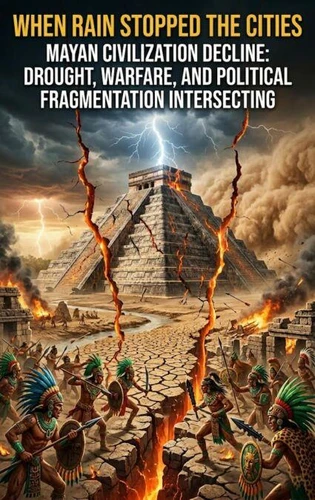
This book explores how the Maya world unraveled when drought, escalating warfare, and fractured city-state politics converged to override the resilience of a once-flourishing Classic-period civilization. Rather than a sudden "vanishing, " it traces a slow reconfiguration of power, settlement, and ritual authority as the celestial rhythms that once sustained divine kingship began to fail.
Drought and climate stress appear as the first intensifying pressure: multi-year dry spells, recorded in cave stalagmites and lake sediments, parched the rain-fed farms and reservoirs on which large centers like Tikal depended, turning surplus into scarcity and undermining the cosmological contract between rulers and gods.
Warfare and militarization mount as the second layer; archaeological evidence now shows that "total war" with high civilian casualties and city-level destruction preceded the worst droughts, shattering supply lines and draining resources needed to sustain populations and elites. Third comes political fragmentation: the Maya were never a single empire but a mosaic of city-states whose rivalries deepened as environmental stress and warfare eroded cooperative networks, leaving no unified response to crisis and accelerating the abandonment of core cities.
Warfare and militarization mount as the second layer; archaeological evidence now shows that "total war" with high civilian casualties and city-level destruction preceded the worst droughts, shattering supply lines and draining resources needed to sustain populations and elites. Third comes political fragmentation: the Maya were never a single empire but a mosaic of city-states whose rivalries deepened as environmental stress and warfare eroded cooperative networks, leaving no unified response to crisis and accelerating the abandonment of core cities.