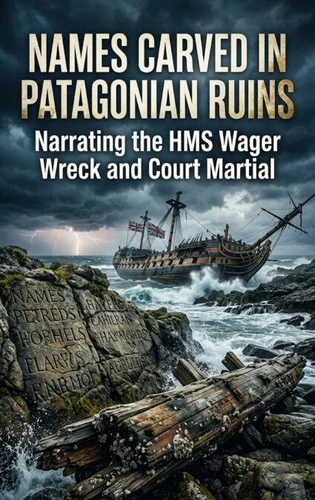
Names Carved in Patagonian Ruins. Narrating the HMS Wager Wreck and Court Martial
Par :Formats :
Disponible dans votre compte client Decitre ou Furet du Nord dès validation de votre commande. Le format ePub est :
- Compatible avec une lecture sur My Vivlio (smartphone, tablette, ordinateur)
- Compatible avec une lecture sur liseuses Vivlio
- Pour les liseuses autres que Vivlio, vous devez utiliser le logiciel Adobe Digital Edition. Non compatible avec la lecture sur les liseuses Kindle, Remarkable et Sony
 , qui est-ce ?
Notre partenaire de plateforme de lecture numérique où vous retrouverez l'ensemble de vos ebooks gratuitement
Pour en savoir plus sur nos ebooks, consultez notre aide en ligne ici
C'est si simple ! Lisez votre ebook avec l'app Vivlio sur votre tablette, mobile ou ordinateur :

- Nombre de pages151
- FormatePub
- ISBN978-3-565-40389-9
- EAN9783565403899
- Date de parution11/04/2026
- Protection num.pas de protection
- Taille2 Mo
- Infos supplémentairesepub
- ÉditeurEmphaloz Publishing House
Résumé
On the night of 14 May 1741, HMS Wager - a converted merchant vessel pressed into service as a Royal Navy warship - struck rocks off the desolate coast of Patagonia during a violent storm. Of the roughly 250 men aboard, only 145 reached the barren, unnamed island that would bear the ship's name. What happened next was not merely a survival story. It was a slow unraveling of command, loyalty, and law at the very edge of the known world.
Captain David Cheap, wounded and increasingly erratic, shot dead an unarmed midshipman, Henry Cozens, for perceived insubordination.
His authority disintegrated. Led by the austere Gunner John Bulkeley, the surviving crew mutinied - arresting their captain, drafting a formal manifesto stripping him of command, and departing the island in an improvised longboat with 81 men. They navigated over 2, 500 miles of storm-wracked, ice-lashed seas through the Strait of Magellan, arriving in Brazil with just 30 survivors alive. Cheap and a handful of loyalists eventually returned separately years later, via Spanish captivity and prisoner exchange. When both parties finally reached England, they told contradictory stories - and each man's version was a bid to escape the gallows.
The court martial convened on 15 April 1746 aboard HMS Prince George at Portsmouth, with testimony from Cheap, Bulkeley, midshipman John Byron - grandfather of the poet - and the gaunt remnants of a crew that had barely outlived their ship. In a verdict that stunned observers, all were acquitted - except one lieutenant admonished for a navigational omission. The Admiralty, embarrassed by the catastrophe, preferred silence over justice.
But the affair left a permanent mark: British naval law was subsequently amended to ensure that sailors remained subject to military discipline even after their ship was lost.
His authority disintegrated. Led by the austere Gunner John Bulkeley, the surviving crew mutinied - arresting their captain, drafting a formal manifesto stripping him of command, and departing the island in an improvised longboat with 81 men. They navigated over 2, 500 miles of storm-wracked, ice-lashed seas through the Strait of Magellan, arriving in Brazil with just 30 survivors alive. Cheap and a handful of loyalists eventually returned separately years later, via Spanish captivity and prisoner exchange. When both parties finally reached England, they told contradictory stories - and each man's version was a bid to escape the gallows.
The court martial convened on 15 April 1746 aboard HMS Prince George at Portsmouth, with testimony from Cheap, Bulkeley, midshipman John Byron - grandfather of the poet - and the gaunt remnants of a crew that had barely outlived their ship. In a verdict that stunned observers, all were acquitted - except one lieutenant admonished for a navigational omission. The Admiralty, embarrassed by the catastrophe, preferred silence over justice.
But the affair left a permanent mark: British naval law was subsequently amended to ensure that sailors remained subject to military discipline even after their ship was lost.