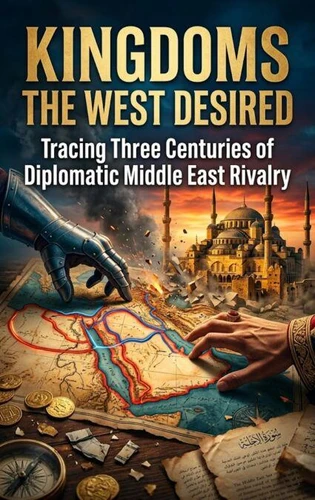
Kingdoms the West Desired. Tracing Three Centuries of Diplomatic Middle East Rivalry
Par :Formats :
Disponible dans votre compte client Decitre ou Furet du Nord dès validation de votre commande. Le format ePub est :
- Compatible avec une lecture sur My Vivlio (smartphone, tablette, ordinateur)
- Compatible avec une lecture sur liseuses Vivlio
- Pour les liseuses autres que Vivlio, vous devez utiliser le logiciel Adobe Digital Edition. Non compatible avec la lecture sur les liseuses Kindle, Remarkable et Sony
 , qui est-ce ?
Notre partenaire de plateforme de lecture numérique où vous retrouverez l'ensemble de vos ebooks gratuitement
Pour en savoir plus sur nos ebooks, consultez notre aide en ligne ici
C'est si simple ! Lisez votre ebook avec l'app Vivlio sur votre tablette, mobile ou ordinateur :

- Nombre de pages263
- FormatePub
- ISBN978-3-565-40910-5
- EAN9783565409105
- Date de parution14/04/2026
- Protection num.pas de protection
- Taille2 Mo
- Infos supplémentairesepub
- ÉditeurEmphaloz Publishing House
Résumé
America's entanglement with the Middle East did not begin with oil, nor with the Cold War, nor with the wars of the twenty-first century. It began with pirates, merchants, and a young republic desperate for legitimacy on the world's oldest stage. In 1777, Morocco became the first foreign nation to recognize American independence. A decade later, over a hundred American sailors languished in Algerian captivity - the first American hostage crisis - while Jefferson and Adams negotiated in a currency of dignity they could not yet afford.
Kingdoms the West Desired traces the full arc of this three-century relationship: from the Barbary Wars of 1801-1805, when Thomas Jefferson dispatched a navy rather than pay tribute to Tripoli, through the missionary networks of the nineteenth century that built colleges in Beirut and Istanbul while quietly remaking local elites, to the seismic rupture of World War II - described by Ambassador Raymond Hare as "the great divide" in American-Middle Eastern relations - when Washington stepped into the vacuum left by crumbling British and French empires and inherited their resentments.
What followed was a foreign policy shaped equally by grand strategy and chronic misreading.
American support for anti-communist monarchies and autocrats - in Iran, Jordan, Saudi Arabia, Egypt - purchased short-term stability at the cost of lasting popular legitimacy. The CIA coup in Iran in 1953, the Eisenhower Doctrine, the arming of Kurdish rebels later abandoned to Iraqi reprisals, the unconditional alliance with Israel that the Arab world read as structural bias - each episode left a sediment of grievance that the next generation of American policymakers inherited without fully understanding.
American support for anti-communist monarchies and autocrats - in Iran, Jordan, Saudi Arabia, Egypt - purchased short-term stability at the cost of lasting popular legitimacy. The CIA coup in Iran in 1953, the Eisenhower Doctrine, the arming of Kurdish rebels later abandoned to Iraqi reprisals, the unconditional alliance with Israel that the Arab world read as structural bias - each episode left a sediment of grievance that the next generation of American policymakers inherited without fully understanding.