She creates books that connect historical insight, business thinking, and personal growth into clear, useful ideas.
Nouveauté
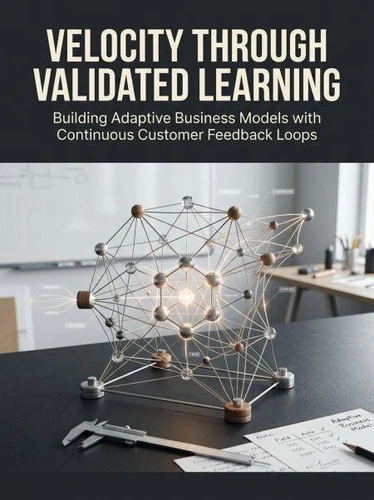
Velocity Through Validated Learning. Building Adaptive Business Models with Continuous Customer Feedback Loops
Par :Formats :
Disponible dans votre compte client Decitre ou Furet du Nord dès validation de votre commande. Le format ePub est :
- Compatible avec une lecture sur My Vivlio (smartphone, tablette, ordinateur)
- Compatible avec une lecture sur liseuses Vivlio
- Pour les liseuses autres que Vivlio, vous devez utiliser le logiciel Adobe Digital Edition. Non compatible avec la lecture sur les liseuses Kindle, Remarkable et Sony
 , qui est-ce ?
Notre partenaire de plateforme de lecture numérique où vous retrouverez l'ensemble de vos ebooks gratuitement
Pour en savoir plus sur nos ebooks, consultez notre aide en ligne ici
C'est si simple ! Lisez votre ebook avec l'app Vivlio sur votre tablette, mobile ou ordinateur :

- Nombre de pages511
- FormatePub
- ISBN978-3-565-60266-7
- EAN9783565602667
- Date de parution30/07/2026
- Protection num.pas de protection
- Taille987 Ko
- Infos supplémentairesepub
- ÉditeurEmphaloz Publishing House
Résumé
Most startups fail not from lack of effort, but from building solutions no one needs. The gap between entrepreneurial vision and market reality destroys more ventures than capital scarcity or competitive pressure. Traditional business planning assumes predictable conditions-a fiction in environments where customer preferences shift faster than product roadmaps.
Validated learning replaces assumption with evidence.
Minimum viable products function as instruments of discovery, not compromise. Each iteration tests a specific hypothesis about value creation. Feedback loops compress the distance between building and knowing. Pivot decisions emerge from data patterns, not founder intuition or board pressure. This methodology reshapes resource allocation. Engineering effort flows toward features customers actually use.
Marketing budgets target segments demonstrably willing to pay. Strategic pivots happen before runway evaporates. The framework applies equally to software platforms, physical products, and service businesses. For organizations operating in fragmented markets or facing technological disruption, the ability to learn faster than competitors becomes the primary competitive advantage. Execution speed matters less than learning velocity.
Minimum viable products function as instruments of discovery, not compromise. Each iteration tests a specific hypothesis about value creation. Feedback loops compress the distance between building and knowing. Pivot decisions emerge from data patterns, not founder intuition or board pressure. This methodology reshapes resource allocation. Engineering effort flows toward features customers actually use.
Marketing budgets target segments demonstrably willing to pay. Strategic pivots happen before runway evaporates. The framework applies equally to software platforms, physical products, and service businesses. For organizations operating in fragmented markets or facing technological disruption, the ability to learn faster than competitors becomes the primary competitive advantage. Execution speed matters less than learning velocity.