She creates books that connect historical insight, business thinking, and personal growth into clear, useful ideas.
Nouveauté
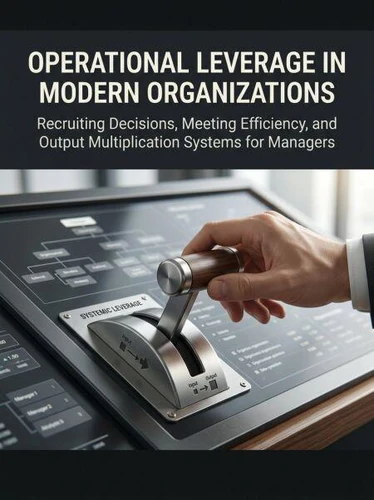
Operational Leverage in Modern Organizations. Recruiting Decisions, Meeting Efficiency, and Output Multiplication Systems for Managers
Par :Formats :
Disponible dans votre compte client Decitre ou Furet du Nord dès validation de votre commande. Le format ePub est :
- Compatible avec une lecture sur My Vivlio (smartphone, tablette, ordinateur)
- Compatible avec une lecture sur liseuses Vivlio
- Pour les liseuses autres que Vivlio, vous devez utiliser le logiciel Adobe Digital Edition. Non compatible avec la lecture sur les liseuses Kindle, Remarkable et Sony
 , qui est-ce ?
Notre partenaire de plateforme de lecture numérique où vous retrouverez l'ensemble de vos ebooks gratuitement
Pour en savoir plus sur nos ebooks, consultez notre aide en ligne ici
C'est si simple ! Lisez votre ebook avec l'app Vivlio sur votre tablette, mobile ou ordinateur :

- Nombre de pages344
- FormatePub
- ISBN978-3-565-60236-0
- EAN9783565602360
- Date de parution30/07/2026
- Protection num.pas de protection
- Taille818 Ko
- Infos supplémentairesepub
- ÉditeurEmphaloz Publishing House
Résumé
Most managers inherit processes designed for stability, not scale. When organizational output stagnates despite increased headcount, the problem is rarely effort-it's operational architecture. This book examines the structural levers that determine whether management activity translates into measurable results or dissipates into coordination overhead.
Three systems define high-output management: recruitment as a filtering mechanism that shapes team capability years in advance, meetings as decision nodes that either compress or expand cycle time, and task design that determines whether individual contributions compound or cancel out.
Each system operates on different time horizons but converges on a single question: how does a manager's time convert into organizational output? The framework applies across industries but reveals its sharpest insights in environments where coordination costs rise faster than team size. For managers navigating distributed teams, matrix reporting structures, or rapid scaling phases, these operational principles offer a diagnostic lens for identifying where leverage is lost and how to recapture it through deliberate process design.
Each system operates on different time horizons but converges on a single question: how does a manager's time convert into organizational output? The framework applies across industries but reveals its sharpest insights in environments where coordination costs rise faster than team size. For managers navigating distributed teams, matrix reporting structures, or rapid scaling phases, these operational principles offer a diagnostic lens for identifying where leverage is lost and how to recapture it through deliberate process design.