Nouveauté
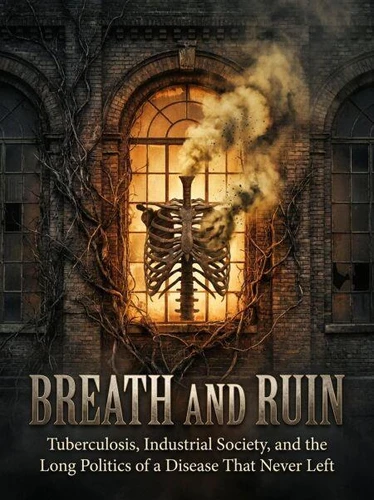
Breath and Ruin. Tuberculosis, Industrial Society, and the Long Politics of a Disease That Never Left
Par :Formats :
Disponible dans votre compte client Decitre ou Furet du Nord dès validation de votre commande. Le format ePub est :
- Compatible avec une lecture sur My Vivlio (smartphone, tablette, ordinateur)
- Compatible avec une lecture sur liseuses Vivlio
- Pour les liseuses autres que Vivlio, vous devez utiliser le logiciel Adobe Digital Edition. Non compatible avec la lecture sur les liseuses Kindle, Remarkable et Sony
 , qui est-ce ?
Notre partenaire de plateforme de lecture numérique où vous retrouverez l'ensemble de vos ebooks gratuitement
Pour en savoir plus sur nos ebooks, consultez notre aide en ligne ici
C'est si simple ! Lisez votre ebook avec l'app Vivlio sur votre tablette, mobile ou ordinateur :

- Nombre de pages570
- FormatePub
- ISBN978-3-565-63443-9
- EAN9783565634439
- Date de parution11/08/2026
- Protection num.pas de protection
- Taille1 Mo
- Infos supplémentairesepub
- ÉditeurEmphaloz Publishing House
Résumé
Few diseases have shaped the modern world as quietly and as thoroughly as tuberculosis. It did not merely kill - it restructured cities, reorganized medical authority, exposed the fracture lines of industrial capitalism, and revealed, with brutal clarity, how political systems decide whose health is worth protecting. From the slums of Victorian Manchester to the sanatoriums of the Swiss Alps, from Robert Koch's laboratory in Berlin to the drug-resistant wards of contemporary Johannesburg, tuberculosis has always been more than a pathogen.
It has been a mirror. The sociology of the disease arrived before its science. Long before Koch identified Mycobacterium tuberculosis in 1882, 19th-century cities had already reorganized themselves around the visible presence of the sick. Sanatorium architecture was not merely therapeutic - it was spatial ideology. Institutions built on elevation, light, and enforced rest encoded class distinctions into their very blueprints.
The working poor coughed in shared tenements; the educated classes retreated to mountain air. Stigma was not accidental. It was structurally produced, inscribed into urban planning, medical discourse, and the language of moral hygiene that framed poverty as contagion and contagion as personal failure. The science of Koch opened a new era - but it did not dissolve the political conditions that allowed tuberculosis to persist.
It has been a mirror. The sociology of the disease arrived before its science. Long before Koch identified Mycobacterium tuberculosis in 1882, 19th-century cities had already reorganized themselves around the visible presence of the sick. Sanatorium architecture was not merely therapeutic - it was spatial ideology. Institutions built on elevation, light, and enforced rest encoded class distinctions into their very blueprints.
The working poor coughed in shared tenements; the educated classes retreated to mountain air. Stigma was not accidental. It was structurally produced, inscribed into urban planning, medical discourse, and the language of moral hygiene that framed poverty as contagion and contagion as personal failure. The science of Koch opened a new era - but it did not dissolve the political conditions that allowed tuberculosis to persist.