Nouveauté
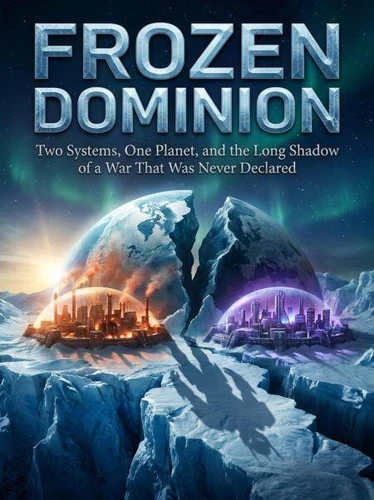
Frozen Dominion. Two Systems, One Planet, and the Long Shadow of a War That Was Never Declared
Par :Formats :
Disponible dans votre compte client Decitre ou Furet du Nord dès validation de votre commande. Le format ePub est :
- Compatible avec une lecture sur My Vivlio (smartphone, tablette, ordinateur)
- Compatible avec une lecture sur liseuses Vivlio
- Pour les liseuses autres que Vivlio, vous devez utiliser le logiciel Adobe Digital Edition. Non compatible avec la lecture sur les liseuses Kindle, Remarkable et Sony
 , qui est-ce ?
Notre partenaire de plateforme de lecture numérique où vous retrouverez l'ensemble de vos ebooks gratuitement
Pour en savoir plus sur nos ebooks, consultez notre aide en ligne ici
C'est si simple ! Lisez votre ebook avec l'app Vivlio sur votre tablette, mobile ou ordinateur :

- Nombre de pages582
- FormatePub
- ISBN978-3-565-63467-5
- EAN9783565634675
- Date de parution11/08/2026
- Protection num.pas de protection
- Taille1 Mo
- Infos supplémentairesepub
- ÉditeurEmphaloz Publishing House
Résumé
For nearly half a century, the world did not live in peace. It lived in suspension - a condition in which the most consequential decisions in human history were made not on battlefields but in the silences between them. The Cold War was not an absence of conflict. It was conflict restructured - dispersed into doctrines, encoded into alliances, and fought through the bodies of nations that never chose the contest.
Its defining tension was not military but philosophical: whether human society could be organized around individual liberty and market logic, or collective purpose and state authority. Both systems arrived at the postwar world bearing the conviction that history had chosen them. The architecture of this rivalry was global but asymmetric. NATO and the Warsaw Pact formalized what had already been decided in the disposition of armies at the end of the Second World War.
But alliances were only the visible structure. Beneath them operated a continuous logic of containment - covert, economic, ideological - that extended from Korea to Guatemala, from Vietnam to Angola. Proxy wars were not aberrations from Cold War strategy. They were its primary instrument, fought at a careful distance from the territories whose destruction would trigger the response no strategist dared model.
The peripheral became the central, and populations across Asia, Africa, and Latin America paid the cost of a stability they had never been consulted about.
Its defining tension was not military but philosophical: whether human society could be organized around individual liberty and market logic, or collective purpose and state authority. Both systems arrived at the postwar world bearing the conviction that history had chosen them. The architecture of this rivalry was global but asymmetric. NATO and the Warsaw Pact formalized what had already been decided in the disposition of armies at the end of the Second World War.
But alliances were only the visible structure. Beneath them operated a continuous logic of containment - covert, economic, ideological - that extended from Korea to Guatemala, from Vietnam to Angola. Proxy wars were not aberrations from Cold War strategy. They were its primary instrument, fought at a careful distance from the territories whose destruction would trigger the response no strategist dared model.
The peripheral became the central, and populations across Asia, Africa, and Latin America paid the cost of a stability they had never been consulted about.