She creates books that connect historical insight, business thinking, and personal growth into clear, useful ideas.
Nouveauté
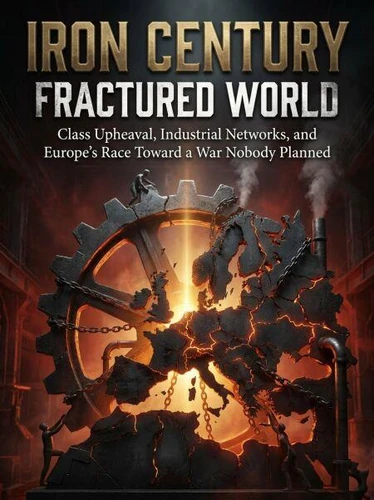
Iron Century, Fractured World. Class Upheaval, Industrial Networks, and Europe's Race Toward a War Nobody Planned
Par :Formats :
Disponible dans votre compte client Decitre ou Furet du Nord dès validation de votre commande. Le format ePub est :
- Compatible avec une lecture sur My Vivlio (smartphone, tablette, ordinateur)
- Compatible avec une lecture sur liseuses Vivlio
- Pour les liseuses autres que Vivlio, vous devez utiliser le logiciel Adobe Digital Edition. Non compatible avec la lecture sur les liseuses Kindle, Remarkable et Sony
 , qui est-ce ?
Notre partenaire de plateforme de lecture numérique où vous retrouverez l'ensemble de vos ebooks gratuitement
Pour en savoir plus sur nos ebooks, consultez notre aide en ligne ici
C'est si simple ! Lisez votre ebook avec l'app Vivlio sur votre tablette, mobile ou ordinateur :

- Nombre de pages606
- FormatePub
- ISBN978-3-565-63478-1
- EAN9783565634781
- Date de parution11/08/2026
- Protection num.pas de protection
- Taille1 Mo
- Infos supplémentairesepub
- ÉditeurEmphaloz Publishing House
Résumé
Between 1815 and 1914, Europe underwent a transformation so profound that the continent that entered the age of railways barely resembled the one that stumbled into the trenches. The old world - governed by hereditary land, inherited deference, and aristocratic certainty - did not simply decline. It was dismantled from below, by forces it had helped set in motion but could not control. The industrial working class did not arrive as a political abstraction.
It arrived as a physical reality: men and women crowded into factory districts, breathing coal smoke, organizing in pub backrooms, demanding recognition from systems designed to exclude them. The structural shift from aristocratic land tenure to industrial wage labor was not merely economic. It was a civilizational renegotiation of who counted, who endured, and who decided. The railway and the telegraph wire were not neutral instruments of progress.
They were architectures of acceleration that made distance irrelevant and reaction time shorter than political institutions could absorb. Capital moved faster than law. Goods crossed borders faster than treaties could regulate them. The urbanization that followed was not planned - it was a consequence of logistics outrunning governance, of machines reorganizing where human beings lived before anyone had thought through what that meant for health, housing, order, or identity. By the century's final decades, the question of power had escaped its European geography entirely.
It arrived as a physical reality: men and women crowded into factory districts, breathing coal smoke, organizing in pub backrooms, demanding recognition from systems designed to exclude them. The structural shift from aristocratic land tenure to industrial wage labor was not merely economic. It was a civilizational renegotiation of who counted, who endured, and who decided. The railway and the telegraph wire were not neutral instruments of progress.
They were architectures of acceleration that made distance irrelevant and reaction time shorter than political institutions could absorb. Capital moved faster than law. Goods crossed borders faster than treaties could regulate them. The urbanization that followed was not planned - it was a consequence of logistics outrunning governance, of machines reorganizing where human beings lived before anyone had thought through what that meant for health, housing, order, or identity. By the century's final decades, the question of power had escaped its European geography entirely.