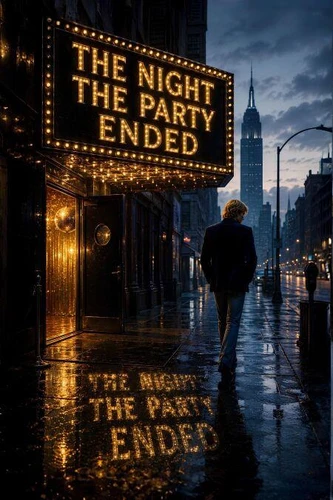
The Night the Party Ended is a sweeping, emotionally charged literary novel about beauty, escape, queer survival, addiction, chosen family, and the cost of being seen too late by a world that has already learned how to use you. Paulie Brennan turns eighteen in 1977 with a one-way bus ticket, a hidden International Male catalog, and a body trained by fear to run before it knows where it is going. Golden-blond, green-eyed, and startlingly beautiful in ways he does not yet understand, Paulie leaves behind a strict Pennsylvania home where his father treated softness as shame and his mother's silence became its own kind of wound.
New York does not create his hunger. It finds it waiting. At first, the city feels like salvation. Christopher Street glows with possibility. Diners become confessionals. Dance floors become sanctuaries. Behind velvet ropes and bathroom mirrors, under disco lights and cigarette smoke, Paulie discovers men who look back at him without disgust, friends who make jokes out of terror, women who protect him with blunt tenderness, and rooms where his body can finally move without a stopwatch, a command, or a father's voice waiting at the finish line.
For the first time, being wanted feels close enough to love that Paulie cannot tell the difference. But the party has its own hunger. The same attention that frees him also begins to price him. Beauty becomes currency, then debt. The generous older patron who opens doors also learns how to close them. The powder on the mirror goes from celebration to maintenance. The laughter grows louder, the mornings harsher, the rooms smaller.
Paulie is not ruined because he wants too much. He is endangered because he has been starved too long. As the glittering world of late-1970s queer nightlife begins to fray under scandal, exhaustion, addiction, and loss, a new fear enters quietly at first: rumor, fever, pneumonia, spots, whispers of "gay cancer, " hospitals where lovers are treated like strangers, funerals that come too often, names that disappear from booths, dance floors, phone lists, and borrowed apartments.
The community dismissed as reckless becomes a community of caretakers. Friends bring soup, cigarettes, socks, gossip, and courage. They sit at bedsides, answer phones, argue with nurses, correct priests, and refuse to let the dying be reduced to warnings. Paulie survives longer than he expects, but survival is not clean. He fails people he loves. He misses what cannot be repaired. He hears his father's old shame inside addiction, inside diagnosis, inside every morning when he wakes and does not know how to live with what he has done or what has been done to him.
Recovery begins not as triumph, but as a room with bad coffee, cheap chairs, fluorescent light, and someone saying he does not have to be brave to stay. Moving from working-class kitchens to Port Authority, from Christopher Street diners to Studio 54-like clubs, from after-hours apartments to hospital corridors and AIDS support rooms, The Night the Party Ended follows one man's passage from escape to collapse, from collapse to witness, and from witness to service.
Paulie does not become a saint. He becomes useful. He becomes someone who answers the phone, brings food, sits with the frightened, and recognizes the newly arrived boy who is trying to disguise desperation as charm. This is a novel about the night that promised freedom, the morning that took its payment, and the people who kept reaching for one another anyway. It honors the joy before the grief, the dancing before the diagnosis, the laughter before the funeral, and the stubborn, sacred work of surviving without betraying the dead.
The party ended. The joy was not false. And Paulie Brennan, carrying all of them, keeps walking toward the next open door.
The Night the Party Ended is a sweeping, emotionally charged literary novel about beauty, escape, queer survival, addiction, chosen family, and the cost of being seen too late by a world that has already learned how to use you. Paulie Brennan turns eighteen in 1977 with a one-way bus ticket, a hidden International Male catalog, and a body trained by fear to run before it knows where it is going. Golden-blond, green-eyed, and startlingly beautiful in ways he does not yet understand, Paulie leaves behind a strict Pennsylvania home where his father treated softness as shame and his mother's silence became its own kind of wound.
New York does not create his hunger. It finds it waiting. At first, the city feels like salvation. Christopher Street glows with possibility. Diners become confessionals. Dance floors become sanctuaries. Behind velvet ropes and bathroom mirrors, under disco lights and cigarette smoke, Paulie discovers men who look back at him without disgust, friends who make jokes out of terror, women who protect him with blunt tenderness, and rooms where his body can finally move without a stopwatch, a command, or a father's voice waiting at the finish line.
For the first time, being wanted feels close enough to love that Paulie cannot tell the difference. But the party has its own hunger. The same attention that frees him also begins to price him. Beauty becomes currency, then debt. The generous older patron who opens doors also learns how to close them. The powder on the mirror goes from celebration to maintenance. The laughter grows louder, the mornings harsher, the rooms smaller.
Paulie is not ruined because he wants too much. He is endangered because he has been starved too long. As the glittering world of late-1970s queer nightlife begins to fray under scandal, exhaustion, addiction, and loss, a new fear enters quietly at first: rumor, fever, pneumonia, spots, whispers of "gay cancer, " hospitals where lovers are treated like strangers, funerals that come too often, names that disappear from booths, dance floors, phone lists, and borrowed apartments.
The community dismissed as reckless becomes a community of caretakers. Friends bring soup, cigarettes, socks, gossip, and courage. They sit at bedsides, answer phones, argue with nurses, correct priests, and refuse to let the dying be reduced to warnings. Paulie survives longer than he expects, but survival is not clean. He fails people he loves. He misses what cannot be repaired. He hears his father's old shame inside addiction, inside diagnosis, inside every morning when he wakes and does not know how to live with what he has done or what has been done to him.
Recovery begins not as triumph, but as a room with bad coffee, cheap chairs, fluorescent light, and someone saying he does not have to be brave to stay. Moving from working-class kitchens to Port Authority, from Christopher Street diners to Studio 54-like clubs, from after-hours apartments to hospital corridors and AIDS support rooms, The Night the Party Ended follows one man's passage from escape to collapse, from collapse to witness, and from witness to service.
Paulie does not become a saint. He becomes useful. He becomes someone who answers the phone, brings food, sits with the frightened, and recognizes the newly arrived boy who is trying to disguise desperation as charm. This is a novel about the night that promised freedom, the morning that took its payment, and the people who kept reaching for one another anyway. It honors the joy before the grief, the dancing before the diagnosis, the laughter before the funeral, and the stubborn, sacred work of surviving without betraying the dead.
The party ended. The joy was not false. And Paulie Brennan, carrying all of them, keeps walking toward the next open door.


 , qui est-ce ?