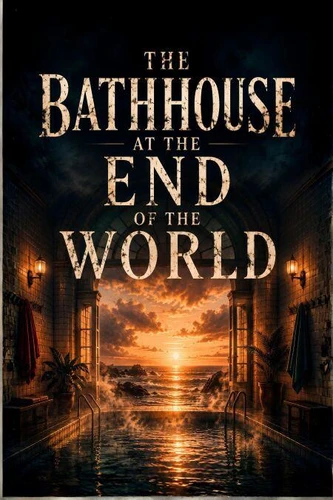
Simon Alder used to be called Father. Now he fixes pipes in a bathhouse no respectable man would admit to entering. After being quietly pushed out of the priesthood, Simon arrives at The Bathhouse at the End of the World after midnight with a toolbox, a borrowed truck, and the private humiliation of a man who has lost the life that once gave him a name. The job is supposed to be temporary: stop a burst pipe, patch what can be patched, make the building a little less likely to collapse before the city inspection.
But the bathhouse is not just a business in decline. It is a crumbling queer sanctuary, a place of steam rooms, bad wiring, old photographs, folded towels, half-told stories, and men who came there when the rest of the world had no room for them. Its owner, Malcolm Veyne, is elegant, pale, evasive, and infuriatingly calm in the face of disaster. He avoids daylight, hates paperwork, dislikes mirrors, keeps impossible hours, and has somehow preserved the bathhouse through decades of raids, grief, scandal, desire, plague, protest, and unpaid invoices.
Darlene Price, the terrifying bookkeeper, suspects tax fraud. Toby Finch, the young social media employee, suspects branding opportunity. Reggie Fontaine, the old front desk manager, knows better than to explain too much. And Simon, who wants only to repair what is visibly broken, begins to realize that the building's deepest damage is hidden behind walls no one has opened in years. When a health complaint, a viral video, and a neighborhood church protest threaten to shut the bathhouse down, Simon is drawn deeper into its history.
Behind the lockers, he discovers an archive of names the world tried to erase: benefit nights from the AIDS years, hospital visitation lists, memorial cards, love letters, membership records, photographs of men laughing, dancing, dying, surviving, and refusing to disappear. At the center of that history is Locker 12, kept polished and empty for a man named Peter D'Amico, who vanished decades earlier after leaving behind a warning no one has ever fully explained.
As Simon fights mold, failing boilers, collapsing ceilings, city inspectors, protest signs, and his own old shame, he begins to understand that the bathhouse is not pure, safe, innocent, or easy to defend. It is messy, erotic, funny, wounded, badly managed, and full of secrets. But it also carried men when churches would not bury them honestly, hospitals would not call their lovers family, and parents refused to claim their sons.
It is a place where desire became shelter, where grief became ritual, and where holiness arrived wearing a towel and complaining about the laundry. And Malcolm is not merely eccentric. The photographs prove he has been there too long. The records carry too many names. The mirrors tell half-truths. The daylight has consequences. Whatever Malcolm is, he has made the bathhouse into a refuge out of hunger, guilt, devotion, and a grief so old it has become architecture.
Funny, tender, gothic, and deeply human, The Bathhouse at the End of the World is a queer supernatural mystery about the places that save us imperfectly, the institutions that fail us politely, and the strange forms grace takes when it has been exiled from respectable rooms. It is a story of broken pipes, unclaimed ashes, old lovers, chosen family, holy desire, and the dangerous mercy of being remembered.
Simon came to fix a leak. Instead, he found a building full of ghosts, a vampire with a compliance problem, and a sanctuary that may be too damaged to save-but too sacred to abandon.
Simon Alder used to be called Father. Now he fixes pipes in a bathhouse no respectable man would admit to entering. After being quietly pushed out of the priesthood, Simon arrives at The Bathhouse at the End of the World after midnight with a toolbox, a borrowed truck, and the private humiliation of a man who has lost the life that once gave him a name. The job is supposed to be temporary: stop a burst pipe, patch what can be patched, make the building a little less likely to collapse before the city inspection.
But the bathhouse is not just a business in decline. It is a crumbling queer sanctuary, a place of steam rooms, bad wiring, old photographs, folded towels, half-told stories, and men who came there when the rest of the world had no room for them. Its owner, Malcolm Veyne, is elegant, pale, evasive, and infuriatingly calm in the face of disaster. He avoids daylight, hates paperwork, dislikes mirrors, keeps impossible hours, and has somehow preserved the bathhouse through decades of raids, grief, scandal, desire, plague, protest, and unpaid invoices.
Darlene Price, the terrifying bookkeeper, suspects tax fraud. Toby Finch, the young social media employee, suspects branding opportunity. Reggie Fontaine, the old front desk manager, knows better than to explain too much. And Simon, who wants only to repair what is visibly broken, begins to realize that the building's deepest damage is hidden behind walls no one has opened in years. When a health complaint, a viral video, and a neighborhood church protest threaten to shut the bathhouse down, Simon is drawn deeper into its history.
Behind the lockers, he discovers an archive of names the world tried to erase: benefit nights from the AIDS years, hospital visitation lists, memorial cards, love letters, membership records, photographs of men laughing, dancing, dying, surviving, and refusing to disappear. At the center of that history is Locker 12, kept polished and empty for a man named Peter D'Amico, who vanished decades earlier after leaving behind a warning no one has ever fully explained.
As Simon fights mold, failing boilers, collapsing ceilings, city inspectors, protest signs, and his own old shame, he begins to understand that the bathhouse is not pure, safe, innocent, or easy to defend. It is messy, erotic, funny, wounded, badly managed, and full of secrets. But it also carried men when churches would not bury them honestly, hospitals would not call their lovers family, and parents refused to claim their sons.
It is a place where desire became shelter, where grief became ritual, and where holiness arrived wearing a towel and complaining about the laundry. And Malcolm is not merely eccentric. The photographs prove he has been there too long. The records carry too many names. The mirrors tell half-truths. The daylight has consequences. Whatever Malcolm is, he has made the bathhouse into a refuge out of hunger, guilt, devotion, and a grief so old it has become architecture.
Funny, tender, gothic, and deeply human, The Bathhouse at the End of the World is a queer supernatural mystery about the places that save us imperfectly, the institutions that fail us politely, and the strange forms grace takes when it has been exiled from respectable rooms. It is a story of broken pipes, unclaimed ashes, old lovers, chosen family, holy desire, and the dangerous mercy of being remembered.
Simon came to fix a leak. Instead, he found a building full of ghosts, a vampire with a compliance problem, and a sanctuary that may be too damaged to save-but too sacred to abandon.

 , qui est-ce ?