SOLDES
Jusqu'à -70% sur une sélection d'articles*

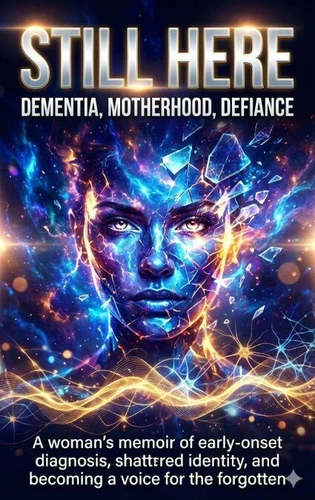
Still Here: Dementia, Motherhood, Defiance. A woman's memoir of early-onset diagnosis, shattered identity, and becoming a voice for the forgotten
Par :Formats :
Disponible dans votre compte client Decitre ou Furet du Nord dès validation de votre commande. Le format ePub est :
- Compatible avec une lecture sur My Vivlio (smartphone, tablette, ordinateur)
- Compatible avec une lecture sur liseuses Vivlio
- Pour les liseuses autres que Vivlio, vous devez utiliser le logiciel Adobe Digital Edition. Non compatible avec la lecture sur les liseuses Kindle, Remarkable et Sony
 , qui est-ce ?
Notre partenaire de plateforme de lecture numérique où vous retrouverez l'ensemble de vos ebooks gratuitement
Pour en savoir plus sur nos ebooks, consultez notre aide en ligne ici
C'est si simple ! Lisez votre ebook avec l'app Vivlio sur votre tablette, mobile ou ordinateur :

- Nombre de pages222
- FormatePub
- ISBN978-3-565-13455-7
- EAN9783565134557
- Date de parution18/12/2025
- Protection num.pas de protection
- Taille354 Ko
- Infos supplémentairesepub
- ÉditeurEmphaloz Publishing House
Résumé
She was forty-two, with two children under ten and a career she loved, when the words "early-onset dementia" rewrote her entire future in a single appointment. The doctor called it "young onset." She called it a thief stealing her life before she'd lived it.
This is the raw, unflinching memoir of a woman who refused to let dementia define her by disappearing quietly. Through intimate diary entries and reflective narration, she documents the terrifying progression: forgetting her daughter's name mid-sentence, getting lost on familiar streets, losing her job because she couldn't remember protocols she'd mastered for years.
The grief of watching herself vanish while still physically present-the "long goodbye" accelerated into cruel daily losses. But this narrative refuses victimhood as endpoint. It chronicles her transformation from patient to advocate, from silent sufferer to public voice. She exposes how healthcare systems are designed for elderly patients, leaving younger people with dementia medically homeless and socially isolated.
She confronts the stigma that assumes dementia means immediate incompetence, fighting for her right to parent, to work, to love, to matter-even as her memory dissolves. Through her children's eyes, she witnesses the particular cruelty of early-onset: her seven-year-old learning to remind Mummy where she left her keys, her ten-year-old developing a hypervigilance no child should carry. Yet she also discovers unexpected gifts: learning to live entirely in the present, finding joy in moments she can't remember tomorrow, building a community of "dementia warriors" who refuse invisibility.
The grief of watching herself vanish while still physically present-the "long goodbye" accelerated into cruel daily losses. But this narrative refuses victimhood as endpoint. It chronicles her transformation from patient to advocate, from silent sufferer to public voice. She exposes how healthcare systems are designed for elderly patients, leaving younger people with dementia medically homeless and socially isolated.
She confronts the stigma that assumes dementia means immediate incompetence, fighting for her right to parent, to work, to love, to matter-even as her memory dissolves. Through her children's eyes, she witnesses the particular cruelty of early-onset: her seven-year-old learning to remind Mummy where she left her keys, her ten-year-old developing a hypervigilance no child should carry. Yet she also discovers unexpected gifts: learning to live entirely in the present, finding joy in moments she can't remember tomorrow, building a community of "dementia warriors" who refuse invisibility.