Jonathan Hayes is an English-language author who writes about psychology, leadership, and personal development. His work blends thoughtful reflection with practical insight, exploring how mindset, resilience, and human behavior influence everyday decisions and long-term growth. His writing style is calm, engaging, and accessible, with a strong focus on clarity, self-awareness, and meaningful change.
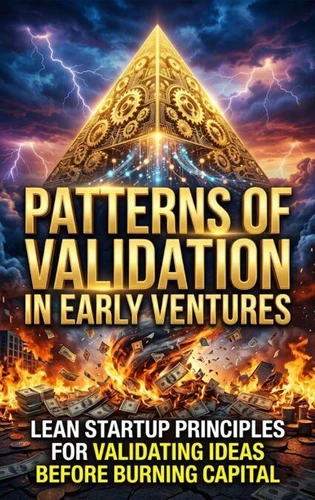
Patterns of Validation in Early Ventures. Lean Startup Principles for Validating Ideas Before Burning Capital
Par :Formats :
Disponible dans votre compte client Decitre ou Furet du Nord dès validation de votre commande. Le format ePub est :
- Compatible avec une lecture sur My Vivlio (smartphone, tablette, ordinateur)
- Compatible avec une lecture sur liseuses Vivlio
- Pour les liseuses autres que Vivlio, vous devez utiliser le logiciel Adobe Digital Edition. Non compatible avec la lecture sur les liseuses Kindle, Remarkable et Sony
 , qui est-ce ?
Notre partenaire de plateforme de lecture numérique où vous retrouverez l'ensemble de vos ebooks gratuitement
Pour en savoir plus sur nos ebooks, consultez notre aide en ligne ici
C'est si simple ! Lisez votre ebook avec l'app Vivlio sur votre tablette, mobile ou ordinateur :

- Nombre de pages132
- FormatePub
- ISBN978-3-565-45402-0
- EAN9783565454020
- Date de parution22/05/2026
- Protection num.pas de protection
- Taille2 Mo
- Infos supplémentairesepub
- ÉditeurEmphaloz Publishing House
Résumé
This book examines how validation patterns emerge when entrepreneurs apply Lean Startup principles to test ideas before committing significant financial resources. It explores the tension between rapid experimentation and capital preservation, focusing on the mechanisms that allow founders to learn from market signals without exhausting limited budgets.
At the center of the analysis is the Build-Measure-Learn feedback loop, presented as a structured system for turning assumptions into experiments, measuring customer responses, and determining whether to pivot or continue development.
By treating each iteration as a learning process rather than a final product, organizations reduce dependence on intuition and align product development more closely with validated customer demand. The book also examines the role of the Minimum Viable Product as a mechanism for reducing waste and accelerating market feedback. Instead of prioritizing feature completeness, this approach emphasizes testing core assumptions through simplified product versions that reveal what customers genuinely value.
In addition, the analysis explores innovation accounting as a framework for measuring progress through actionable metrics rather than superficial growth indicators, helping founders evaluate whether experimentation is generating meaningful insight and sustainable momentum. Together, these validation patterns shape how organizations interpret market shifts, allocate resources, and adapt to uncertainty, particularly within German and broader European innovation environments, without prescribing rigid formulas or guaranteed outcomes.
By treating each iteration as a learning process rather than a final product, organizations reduce dependence on intuition and align product development more closely with validated customer demand. The book also examines the role of the Minimum Viable Product as a mechanism for reducing waste and accelerating market feedback. Instead of prioritizing feature completeness, this approach emphasizes testing core assumptions through simplified product versions that reveal what customers genuinely value.
In addition, the analysis explores innovation accounting as a framework for measuring progress through actionable metrics rather than superficial growth indicators, helping founders evaluate whether experimentation is generating meaningful insight and sustainable momentum. Together, these validation patterns shape how organizations interpret market shifts, allocate resources, and adapt to uncertainty, particularly within German and broader European innovation environments, without prescribing rigid formulas or guaranteed outcomes.