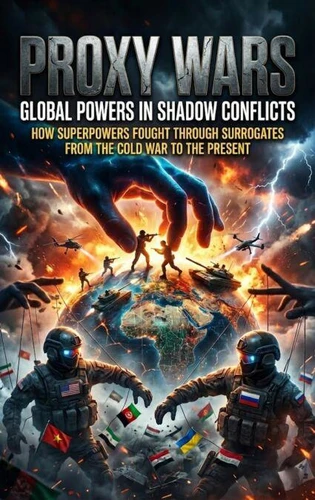
Proxy Wars: Global Powers in Shadow Conflicts. How Superpowers Fought Through Surrogates from the Cold War to the Present
Par :Formats :
Disponible dans votre compte client Decitre ou Furet du Nord dès validation de votre commande. Le format ePub est :
- Compatible avec une lecture sur My Vivlio (smartphone, tablette, ordinateur)
- Compatible avec une lecture sur liseuses Vivlio
- Pour les liseuses autres que Vivlio, vous devez utiliser le logiciel Adobe Digital Edition. Non compatible avec la lecture sur les liseuses Kindle, Remarkable et Sony
 , qui est-ce ?
Notre partenaire de plateforme de lecture numérique où vous retrouverez l'ensemble de vos ebooks gratuitement
Pour en savoir plus sur nos ebooks, consultez notre aide en ligne ici
C'est si simple ! Lisez votre ebook avec l'app Vivlio sur votre tablette, mobile ou ordinateur :

- Nombre de pages200
- FormatePub
- ISBN978-3-565-24966-4
- EAN9783565249664
- Date de parution15/02/2026
- Protection num.pas de protection
- Taille2 Mo
- Infos supplémentairesepub
- ÉditeurEmphaloz Publishing House
Résumé
Proxy warfare allows major powers to advance strategic interests, test military capabilities, and weaken rivals without direct confrontation that risks nuclear escalation or domestic political backlash. This comprehensive analysis examines how superpowers have manipulated regional conflicts across seven decades-from Korea and Vietnam through Afghanistan and Angola to Syria and Yemen-exploring the mechanisms of indirect warfare, the consequences for proxy states, and why this strategy persists despite its destabilizing effects.
Drawing on declassified documents, military analyses, diplomatic cables, and regional histories, this book reveals how powers select and support proxies, what they provide beyond weapons and funding, and how proxy relationships evolve from alignment to autonomy or abandonment.
It explores the asymmetry between sponsors' limited commitments and proxies' existential stakes, how regional conflicts become internationalized, and the humanitarian costs of prolonged warfare fueled by external support. The narrative examines patterns across conflicts while respecting local agency and specific contexts, analyzing how proxy wars serve great power competition, how they destabilize regions long after sponsors lose interest, and what intervention reveals about international law's limitations.
It addresses the difficulty of ending proxy conflicts, the legacy of weapons proliferation, and how external support prolongs wars that might otherwise reach negotiated settlements. This work provides rigorous analysis of indirect warfare's strategic logic and human consequences.
It explores the asymmetry between sponsors' limited commitments and proxies' existential stakes, how regional conflicts become internationalized, and the humanitarian costs of prolonged warfare fueled by external support. The narrative examines patterns across conflicts while respecting local agency and specific contexts, analyzing how proxy wars serve great power competition, how they destabilize regions long after sponsors lose interest, and what intervention reveals about international law's limitations.
It addresses the difficulty of ending proxy conflicts, the legacy of weapons proliferation, and how external support prolongs wars that might otherwise reach negotiated settlements. This work provides rigorous analysis of indirect warfare's strategic logic and human consequences.
A propos de Thalia Brookstone
















8,99 €