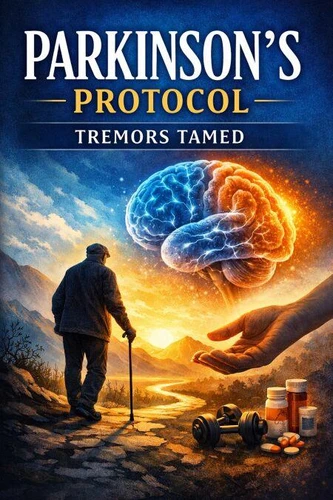
Parkinson’s Protocol: Tremors Tamed
Par :Formats :
Disponible dans votre compte client Decitre ou Furet du Nord dès validation de votre commande. Le format ePub est :
- Compatible avec une lecture sur My Vivlio (smartphone, tablette, ordinateur)
- Compatible avec une lecture sur liseuses Vivlio
- Pour les liseuses autres que Vivlio, vous devez utiliser le logiciel Adobe Digital Edition. Non compatible avec la lecture sur les liseuses Kindle, Remarkable et Sony
 , qui est-ce ?
Notre partenaire de plateforme de lecture numérique où vous retrouverez l'ensemble de vos ebooks gratuitement
Pour en savoir plus sur nos ebooks, consultez notre aide en ligne ici
C'est si simple ! Lisez votre ebook avec l'app Vivlio sur votre tablette, mobile ou ordinateur :

- FormatePub
- ISBN8235111233
- EAN9798235111233
- Date de parution19/04/2026
- Protection num.pas de protection
- Infos supplémentairesepub
- ÉditeurIoakim Ioakim
Résumé
Parkinson's Protocol: Tremors Tamed is a compassionate and practical guide for anyone seeking to understand, manage, and live more confidently with Parkinson's disease. Written in an accessible yet deeply reflective style, this book explores Parkinson's not only as a neurological movement disorder, but as a condition that affects the whole person-body, mind, emotions, relationships, daily routines, and future planning.
It is designed for patients, caregivers, families, and readers who want a fuller picture of what Parkinson's disease truly means in lived experience. Beginning with the earliest signs and the journey to diagnosis, the book carefully explains the science behind Parkinson's disease, including the role of dopamine, the causes of motor symptoms, and the often-overlooked non-motor burdens such as sleep disruption, fatigue, depression, anxiety, constipation, and cognitive changes.
It then moves beyond medical explanation to provide a comprehensive roadmap for living better with the condition. Readers are guided through medications, treatment options, advanced therapies, nutrition, exercise, physical therapy, occupational therapy, speech support, rest, energy management, emotional resilience, and caregiving dynamics. What makes this book especially valuable is its whole-life approach.
Rather than offering false promises or simplistic cures, Parkinson's Protocol: Tremors Tamed presents a balanced and realistic philosophy of care. It shows how small, consistent actions-proper medication timing, safe movement, supportive nutrition, thoughtful home adjustments, emotional honesty, and future planning-can combine into a powerful personal protocol for improving quality of life. Each chapter emphasizes not only symptom management, but also dignity, adaptation, and practical hope.
The book also speaks with sensitivity to the emotional realities of Parkinson's disease. It addresses the grief of changing ability, the fear of becoming dependent, the burden on caregivers, the strain on relationships, and the importance of preserving meaning and identity in the face of chronic illness. It encourages readers to see that Parkinson's may change life, but it does not erase the possibility of joy, contribution, love, and purpose.
Rich in insight and grounded in everyday reality, this book is both educational and encouraging. It serves as a guide for those newly diagnosed, a source of reassurance for families, and a companion for long-term patients seeking renewed structure and strength. More than a medical overview, it is a book about living wisely and courageously with a difficult condition. Parkinson's Protocol: Tremors Tamed ultimately offers a clear message: while Parkinson's disease may not be fully cured, much can be done to tame its impact, preserve independence, and help life remain meaningful, connected, and deeply human.
It is designed for patients, caregivers, families, and readers who want a fuller picture of what Parkinson's disease truly means in lived experience. Beginning with the earliest signs and the journey to diagnosis, the book carefully explains the science behind Parkinson's disease, including the role of dopamine, the causes of motor symptoms, and the often-overlooked non-motor burdens such as sleep disruption, fatigue, depression, anxiety, constipation, and cognitive changes.
It then moves beyond medical explanation to provide a comprehensive roadmap for living better with the condition. Readers are guided through medications, treatment options, advanced therapies, nutrition, exercise, physical therapy, occupational therapy, speech support, rest, energy management, emotional resilience, and caregiving dynamics. What makes this book especially valuable is its whole-life approach.
Rather than offering false promises or simplistic cures, Parkinson's Protocol: Tremors Tamed presents a balanced and realistic philosophy of care. It shows how small, consistent actions-proper medication timing, safe movement, supportive nutrition, thoughtful home adjustments, emotional honesty, and future planning-can combine into a powerful personal protocol for improving quality of life. Each chapter emphasizes not only symptom management, but also dignity, adaptation, and practical hope.
The book also speaks with sensitivity to the emotional realities of Parkinson's disease. It addresses the grief of changing ability, the fear of becoming dependent, the burden on caregivers, the strain on relationships, and the importance of preserving meaning and identity in the face of chronic illness. It encourages readers to see that Parkinson's may change life, but it does not erase the possibility of joy, contribution, love, and purpose.
Rich in insight and grounded in everyday reality, this book is both educational and encouraging. It serves as a guide for those newly diagnosed, a source of reassurance for families, and a companion for long-term patients seeking renewed structure and strength. More than a medical overview, it is a book about living wisely and courageously with a difficult condition. Parkinson's Protocol: Tremors Tamed ultimately offers a clear message: while Parkinson's disease may not be fully cured, much can be done to tame its impact, preserve independence, and help life remain meaningful, connected, and deeply human.
A propos de Dilip Kumar Agrawal


2,99 €

2,99 €

2,99 €

2,99 €

2,99 €



2,99 €

2,99 €

2,99 €

2,99 €

2,99 €

2,99 €



2,99 €