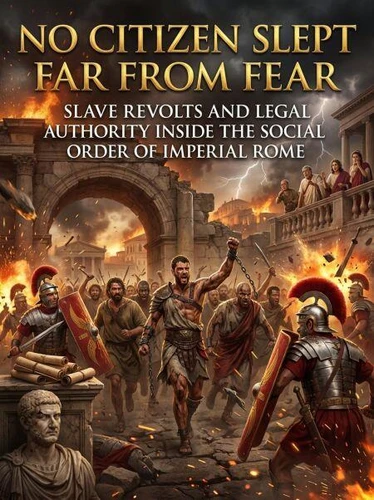
No Citizen Slept Far from Fear. Slave revolts and legal authority inside the social order of imperial Rome
Par :Formats :
Disponible dans votre compte client Decitre ou Furet du Nord dès validation de votre commande. Le format ePub est :
- Compatible avec une lecture sur My Vivlio (smartphone, tablette, ordinateur)
- Compatible avec une lecture sur liseuses Vivlio
- Pour les liseuses autres que Vivlio, vous devez utiliser le logiciel Adobe Digital Edition. Non compatible avec la lecture sur les liseuses Kindle, Remarkable et Sony
 , qui est-ce ?
Notre partenaire de plateforme de lecture numérique où vous retrouverez l'ensemble de vos ebooks gratuitement
Pour en savoir plus sur nos ebooks, consultez notre aide en ligne ici
C'est si simple ! Lisez votre ebook avec l'app Vivlio sur votre tablette, mobile ou ordinateur :

- Nombre de pages158
- FormatePub
- ISBN978-3-565-48640-3
- EAN9783565486403
- Date de parution08/06/2026
- Protection num.pas de protection
- Taille1 Mo
- Infos supplémentairesepub
- ÉditeurEmphaloz Publishing House
Résumé
Roman power depended as much on fear as on law. Behind the stability of the empire stood constant anxiety over revolt, sabotage, and the possibility that millions of enslaved workers might refuse obedience at once. Military force and legal control therefore became inseparable from everyday economic life.
This account investigates how Roman authorities managed large populations of enslaved laborers through surveillance, punishment, and carefully structured dependency.
Plantation estates, urban households, and mining operations all developed systems intended to prevent collective resistance before it emerged openly. Public executions, restricted movement, and military intervention functioned not only as discipline, but as political theater reinforcing elite dominance. The book also examines the legal complexity of slavery in Roman society. Manumission allowed selected individuals to acquire limited rights and economic participation, creating incentives for compliance while preserving broader hierarchies of ownership.
Roman jurists treated human beings simultaneously as labor assets, legal property, and potential social threats requiring continuous regulation. Seen through rebellion and repression, imperial Rome appears less as a unified civilization than as a fragile order sustained by calculated inequality and permanent coercion.
Plantation estates, urban households, and mining operations all developed systems intended to prevent collective resistance before it emerged openly. Public executions, restricted movement, and military intervention functioned not only as discipline, but as political theater reinforcing elite dominance. The book also examines the legal complexity of slavery in Roman society. Manumission allowed selected individuals to acquire limited rights and economic participation, creating incentives for compliance while preserving broader hierarchies of ownership.
Roman jurists treated human beings simultaneously as labor assets, legal property, and potential social threats requiring continuous regulation. Seen through rebellion and repression, imperial Rome appears less as a unified civilization than as a fragile order sustained by calculated inequality and permanent coercion.