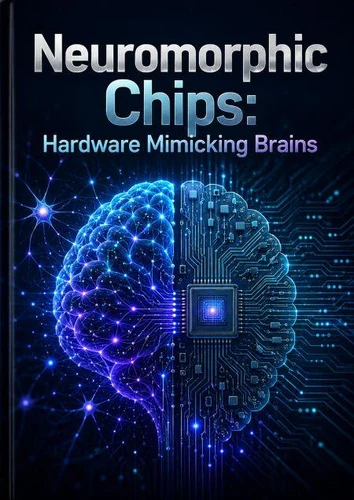
Neuromorphic Chips: Hardware Mimicking Brains
Par :Formats :
Disponible dans votre compte client Decitre ou Furet du Nord dès validation de votre commande. Le format ePub est :
- Compatible avec une lecture sur My Vivlio (smartphone, tablette, ordinateur)
- Compatible avec une lecture sur liseuses Vivlio
- Pour les liseuses autres que Vivlio, vous devez utiliser le logiciel Adobe Digital Edition. Non compatible avec la lecture sur les liseuses Kindle, Remarkable et Sony
 , qui est-ce ?
Notre partenaire de plateforme de lecture numérique où vous retrouverez l'ensemble de vos ebooks gratuitement
Pour en savoir plus sur nos ebooks, consultez notre aide en ligne ici
C'est si simple ! Lisez votre ebook avec l'app Vivlio sur votre tablette, mobile ou ordinateur :

- FormatePub
- ISBN8233942075
- EAN9798233942075
- Date de parution13/05/2026
- Protection num.pas de protection
- Infos supplémentairesepub
- ÉditeurLinda Balsamo
Résumé
Neuromorphic Chips: Hardware Mimicking Brains is a thoughtful and accessible exploration of one of the most exciting frontiers in modern computing: the development of hardware inspired by the human brain. As artificial intelligence grows more powerful and more widely used, traditional computer systems face increasing challenges in energy consumption, data movement, real-time response, and adaptability.
This book explains how neuromorphic chips offer a new path forward by imitating selected principles of biological nervous systems. The book begins by tracing the rise of brain-inspired computing and explaining why conventional computer architecture, especially the von Neumann model, is reaching important limits. In traditional machines, memory and processing are separated, forcing data to travel constantly between storage and computation units.
This movement consumes energy and creates delays. The human brain, however, operates differently. It combines memory and processing through networks of neurons and synapses, communicates through electrical spikes, and learns by changing its own connections. Neuromorphic chips attempt to translate these biological ideas into electronic hardware. Through clear and bookish explanation, the book introduces the reader to neurons, synapses, spiking signals, and spiking neural networks.
It shows how information can be processed through events rather than constant streams of data. This event-driven style allows neuromorphic systems to remain mostly quiet when nothing important is happening and respond quickly when meaningful changes occur. Such efficiency makes them especially valuable for edge AI, robotics, medical devices, smart sensors, autonomous machines, and environmental monitoring.
The book also explores the hardware design of neuromorphic chips, including artificial neurons, artificial synapses, analog and digital circuits, memory-processing integration, and emerging technologies such as memristors. It explains why bringing memory and computation closer together is essential for overcoming the energy limits of conventional computing. By reducing unnecessary data movement, neuromorphic systems may help create greener and more sustainable artificial intelligence.
Applications form a major part of the discussion. The book examines how neuromorphic chips may transform robotics, autonomous vehicles, drones, prosthetics, hearing aids, medical monitors, event-based cameras, tactile sensors, and smart infrastructure. It shows how brain-inspired hardware can help machines sense, react, and adapt in real time while using less power. At the same time, the book presents a balanced view by addressing the technical challenges that remain, including programming difficulty, training spiking neural networks, hardware reliability, scalability, manufacturing cost, and software ecosystem limitations.
Beyond engineering, the book considers the ethical, social, and economic impact of neuromorphic technology. It raises important questions about privacy, surveillance, automation, military use, healthcare responsibility, employment, accessibility, and environmental sustainability. The book emphasizes that powerful technology must be guided by human wisdom, not merely technical ambition. Overall, Neuromorphic Chips: Hardware Mimicking Brains presents neuromorphic computing as a bridge between biology and technology.
It is a book about machines learning from the brain-not to become human, but to become more efficient, adaptive, responsive, and sustainable in a rapidly changing digital world.
This book explains how neuromorphic chips offer a new path forward by imitating selected principles of biological nervous systems. The book begins by tracing the rise of brain-inspired computing and explaining why conventional computer architecture, especially the von Neumann model, is reaching important limits. In traditional machines, memory and processing are separated, forcing data to travel constantly between storage and computation units.
This movement consumes energy and creates delays. The human brain, however, operates differently. It combines memory and processing through networks of neurons and synapses, communicates through electrical spikes, and learns by changing its own connections. Neuromorphic chips attempt to translate these biological ideas into electronic hardware. Through clear and bookish explanation, the book introduces the reader to neurons, synapses, spiking signals, and spiking neural networks.
It shows how information can be processed through events rather than constant streams of data. This event-driven style allows neuromorphic systems to remain mostly quiet when nothing important is happening and respond quickly when meaningful changes occur. Such efficiency makes them especially valuable for edge AI, robotics, medical devices, smart sensors, autonomous machines, and environmental monitoring.
The book also explores the hardware design of neuromorphic chips, including artificial neurons, artificial synapses, analog and digital circuits, memory-processing integration, and emerging technologies such as memristors. It explains why bringing memory and computation closer together is essential for overcoming the energy limits of conventional computing. By reducing unnecessary data movement, neuromorphic systems may help create greener and more sustainable artificial intelligence.
Applications form a major part of the discussion. The book examines how neuromorphic chips may transform robotics, autonomous vehicles, drones, prosthetics, hearing aids, medical monitors, event-based cameras, tactile sensors, and smart infrastructure. It shows how brain-inspired hardware can help machines sense, react, and adapt in real time while using less power. At the same time, the book presents a balanced view by addressing the technical challenges that remain, including programming difficulty, training spiking neural networks, hardware reliability, scalability, manufacturing cost, and software ecosystem limitations.
Beyond engineering, the book considers the ethical, social, and economic impact of neuromorphic technology. It raises important questions about privacy, surveillance, automation, military use, healthcare responsibility, employment, accessibility, and environmental sustainability. The book emphasizes that powerful technology must be guided by human wisdom, not merely technical ambition. Overall, Neuromorphic Chips: Hardware Mimicking Brains presents neuromorphic computing as a bridge between biology and technology.
It is a book about machines learning from the brain-not to become human, but to become more efficient, adaptive, responsive, and sustainable in a rapidly changing digital world.
A propos de Dilip Kumar Agrawal



2,99 €

2,99 €

2,99 €

2,99 €

2,99 €



2,99 €

2,99 €

2,99 €

2,99 €

2,99 €

2,99 €



2,99 €