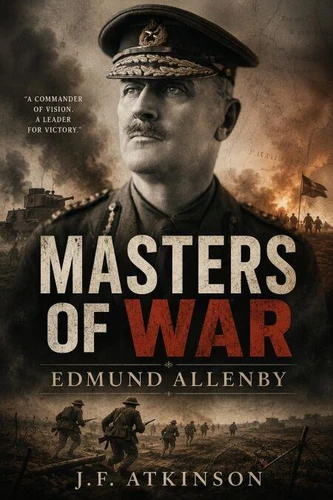
MASTERS OF WAR: EDMUND ALLENBY The Last Great Cavalry Commander and the Conquest of PalestineFrom the sun-scorched deserts of the Middle East to the blood-soaked trenches of the Western Front, Field Marshal Edmund Allenby's military career spanned the transformation of warfare from Victorian colonial campaigns to the mechanized slaughter of the First World War. This comprehensive biography examines one of Britain's most successful, yet often overlooked, commanders whose brilliant victories in Palestine stand in stark contrast to the stalemate that consumed millions on the Western Front.
Born into Victorian England in 1861, Allenby embodied the values of his age: duty, courage, and unwavering service to the Crown and Empire. Rising through the cavalry ranks from the veldt of South Africa to the killing fields of France, he experienced firsthand the brutal evolution of modern warfare. After a controversial tenure commanding the Third Army at Arras, where initial success dissolved into costly attrition, Allenby faced what appeared to be career-ending reassignment to the Egyptian Expeditionary Force, a backwater command far from the war's decisive theater.
What seemed like exile became an opportunity for redemption. In the deserts and hills of Palestine, Allenby orchestrated one of military history's most brilliant campaigns. Through sophisticated deception, meticulous logistics, and aggressive exploitation, he shattered Ottoman defenses at Beersheba, captured Jerusalem, and achieved the complete destruction of three Turkish armies at Megiddo, advancing over 350 miles in six weeks while suffering minimal casualties.
His campaigns became textbook examples of operational art, studied by military professionals worldwide and influencing doctrine from the Second World War through modern conflicts. Yet Allenby was no simple military genius. Known as "The Bull" for his imposing presence and volatile temperament, he struggled with the complexities of high command, clashed with superiors, and faced the moral ambiguities of counterinsurgency warfare and imperial governance.
As High Commissioner of Egypt, he navigated the treacherous waters of post-war nationalism, balancing British imperial interests against Egyptian aspirations for independence. His personal life bore profound tragedy, the loss of his only son in combat, that shadowed even his greatest triumphs. This volume in the Masters of War series provides an unflinching examination of Allenby's life, command style, and military innovations.
Drawing on campaign records, personal correspondence, and contemporary accounts, it analyzes what made his Palestinian victories possible while Western Front operations remained stalemated. It explores his sophisticated use of intelligence and deception, his integration of cavalry with modern combined arms warfare, and his development of operational concepts that translated tactical success into strategic victory.
MASTERS OF WAR: EDMUND ALLENBY The Last Great Cavalry Commander and the Conquest of PalestineFrom the sun-scorched deserts of the Middle East to the blood-soaked trenches of the Western Front, Field Marshal Edmund Allenby's military career spanned the transformation of warfare from Victorian colonial campaigns to the mechanized slaughter of the First World War. This comprehensive biography examines one of Britain's most successful, yet often overlooked, commanders whose brilliant victories in Palestine stand in stark contrast to the stalemate that consumed millions on the Western Front.
Born into Victorian England in 1861, Allenby embodied the values of his age: duty, courage, and unwavering service to the Crown and Empire. Rising through the cavalry ranks from the veldt of South Africa to the killing fields of France, he experienced firsthand the brutal evolution of modern warfare. After a controversial tenure commanding the Third Army at Arras, where initial success dissolved into costly attrition, Allenby faced what appeared to be career-ending reassignment to the Egyptian Expeditionary Force, a backwater command far from the war's decisive theater.
What seemed like exile became an opportunity for redemption. In the deserts and hills of Palestine, Allenby orchestrated one of military history's most brilliant campaigns. Through sophisticated deception, meticulous logistics, and aggressive exploitation, he shattered Ottoman defenses at Beersheba, captured Jerusalem, and achieved the complete destruction of three Turkish armies at Megiddo, advancing over 350 miles in six weeks while suffering minimal casualties.
His campaigns became textbook examples of operational art, studied by military professionals worldwide and influencing doctrine from the Second World War through modern conflicts. Yet Allenby was no simple military genius. Known as "The Bull" for his imposing presence and volatile temperament, he struggled with the complexities of high command, clashed with superiors, and faced the moral ambiguities of counterinsurgency warfare and imperial governance.
As High Commissioner of Egypt, he navigated the treacherous waters of post-war nationalism, balancing British imperial interests against Egyptian aspirations for independence. His personal life bore profound tragedy, the loss of his only son in combat, that shadowed even his greatest triumphs. This volume in the Masters of War series provides an unflinching examination of Allenby's life, command style, and military innovations.
Drawing on campaign records, personal correspondence, and contemporary accounts, it analyzes what made his Palestinian victories possible while Western Front operations remained stalemated. It explores his sophisticated use of intelligence and deception, his integration of cavalry with modern combined arms warfare, and his development of operational concepts that translated tactical success into strategic victory.

 , qui est-ce ?