SOLDES
Jusqu'à -70% sur une sélection d'articles*

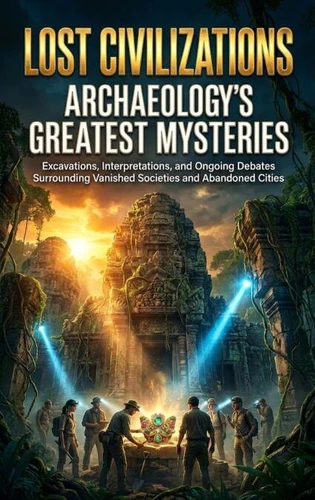
Lost Civilizations: Archaeology's Greatest Mysteries. Excavations, Interpretations, and Ongoing Debates Surrounding Vanished Societies and Abandoned Cities
Par :Formats :
Disponible dans votre compte client Decitre ou Furet du Nord dès validation de votre commande. Le format ePub est :
- Compatible avec une lecture sur My Vivlio (smartphone, tablette, ordinateur)
- Compatible avec une lecture sur liseuses Vivlio
- Pour les liseuses autres que Vivlio, vous devez utiliser le logiciel Adobe Digital Edition. Non compatible avec la lecture sur les liseuses Kindle, Remarkable et Sony
 , qui est-ce ?
Notre partenaire de plateforme de lecture numérique où vous retrouverez l'ensemble de vos ebooks gratuitement
Pour en savoir plus sur nos ebooks, consultez notre aide en ligne ici
C'est si simple ! Lisez votre ebook avec l'app Vivlio sur votre tablette, mobile ou ordinateur :

- Nombre de pages194
- FormatePub
- ISBN978-3-565-24613-7
- EAN9783565246137
- Date de parution14/02/2026
- Protection num.pas de protection
- Taille2 Mo
- Infos supplémentairesepub
- ÉditeurEmphaloz Publishing House
Résumé
Archaeological sites across the globe preserve evidence of complex societies that collapsed, migrated, or transformed so completely that their material remains pose more questions than answers. From Göbekli Tepe's megalithic structures predating agriculture to the sudden abandonment of Cahokia's urban center, from the undeciphered Indus Valley script to the enigmatic purpose of Stonehenge, these sites challenge conventional narratives about human development and social organization.
This book examines the most compelling archaeological puzzles through the lens of scientific methodology and scholarly debate.
Drawing on excavation reports, radiocarbon dating, linguistic analysis, and comparative studies, it explores what evidence reveals about these vanished societies and where interpretation remains contested. The narrative distinguishes between documented facts and speculative theories while acknowledging the limitations of archaeological reconstruction. Each chapter focuses on a specific site or civilization, presenting the discoveries that sparked initial interest, subsequent excavations that complicated early interpretations, and current scholarly consensus alongside ongoing disputes.
The book explores methodological challenges archaeologists face: fragmentary evidence, contaminated stratigraphy, looted artifacts, and the difficulty of reconstructing social structures from material culture alone. Readers encounter the Minoans whose palace complexes suddenly ceased functioning around 1450 BCE, the Ancestral Puebloans who abandoned cliff dwellings in the American Southwest, the Easter Island societies whose moai construction reflected complex social hierarchies, and the Khmer Empire whose hydraulic engineering supported Angkor's massive population.
The book examines competing theories about each civilization's decline-environmental collapse, warfare, disease, social transformation-and evaluates evidence supporting different interpretations.
Drawing on excavation reports, radiocarbon dating, linguistic analysis, and comparative studies, it explores what evidence reveals about these vanished societies and where interpretation remains contested. The narrative distinguishes between documented facts and speculative theories while acknowledging the limitations of archaeological reconstruction. Each chapter focuses on a specific site or civilization, presenting the discoveries that sparked initial interest, subsequent excavations that complicated early interpretations, and current scholarly consensus alongside ongoing disputes.
The book explores methodological challenges archaeologists face: fragmentary evidence, contaminated stratigraphy, looted artifacts, and the difficulty of reconstructing social structures from material culture alone. Readers encounter the Minoans whose palace complexes suddenly ceased functioning around 1450 BCE, the Ancestral Puebloans who abandoned cliff dwellings in the American Southwest, the Easter Island societies whose moai construction reflected complex social hierarchies, and the Khmer Empire whose hydraulic engineering supported Angkor's massive population.
The book examines competing theories about each civilization's decline-environmental collapse, warfare, disease, social transformation-and evaluates evidence supporting different interpretations.
A propos de Mae Collinsworth















8,99 €

8,99 €