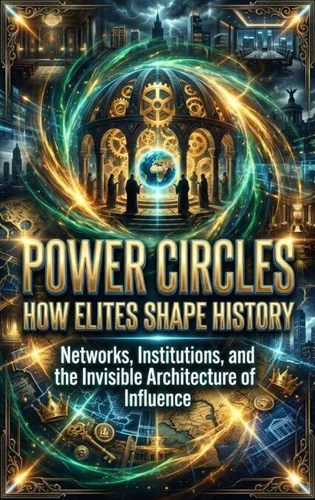
Power Circles: How Elites Shape History. Networks, Institutions, and the Invisible Architecture of Influence
Par :Formats :
Disponible dans votre compte client Decitre ou Furet du Nord dès validation de votre commande. Le format ePub est :
- Compatible avec une lecture sur My Vivlio (smartphone, tablette, ordinateur)
- Compatible avec une lecture sur liseuses Vivlio
- Pour les liseuses autres que Vivlio, vous devez utiliser le logiciel Adobe Digital Edition. Non compatible avec la lecture sur les liseuses Kindle, Remarkable et Sony
 , qui est-ce ?
Notre partenaire de plateforme de lecture numérique où vous retrouverez l'ensemble de vos ebooks gratuitement
Pour en savoir plus sur nos ebooks, consultez notre aide en ligne ici
C'est si simple ! Lisez votre ebook avec l'app Vivlio sur votre tablette, mobile ou ordinateur :

- Nombre de pages172
- FormatePub
- ISBN978-3-565-28009-4
- EAN9783565280094
- Date de parution27/02/2026
- Protection num.pas de protection
- Taille2 Mo
- Infos supplémentairesepub
- ÉditeurEmphaloz Publishing House
Résumé
History is rarely made by individuals acting alone. Behind the visible events of wars, revolutions, financial crises, and political transformations lies a more durable force: the organized networks of elite individuals whose relationships, shared interests, and institutional positions allow them to shape outcomes far beyond what any single actor could achieve. Power Circles examines this phenomenon across modern history-from the interlocking directorates of late nineteenth-century industrial capitalism through the transatlantic policy networks of the Cold War, the Davos consensus of the 1990s, and the concentrated tech-financial elite of the twenty-first century.
Drawing on sociological research, declassified government records, corporate board histories, philanthropic foundation archives, and the scholarship of political scientists specializing in elite theory, each chapter reconstructs how specific networks formed, how they maintained cohesion across institutional boundaries, and how they translated social connection into political and economic outcomes.
The book draws a careful distinction between the documented exercise of network influence and conspiratorial mythology-examining what the historical and sociological record actually demonstrates about how power concentrates, circulates, and perpetuates itself across generations. The final section examines contemporary elite formation: how digital-era wealth has created new network architectures, how philanthropic institutions now perform functions once reserved for states, and how the revolving door between regulatory bodies and private finance has reshaped democratic accountability in ways that primary sources document with uncomfortable clarity.
Power Circles is a serious, evidence-based history of influence-essential for readers who understand that the most consequential decisions in modern history were rarely made in public.
The book draws a careful distinction between the documented exercise of network influence and conspiratorial mythology-examining what the historical and sociological record actually demonstrates about how power concentrates, circulates, and perpetuates itself across generations. The final section examines contemporary elite formation: how digital-era wealth has created new network architectures, how philanthropic institutions now perform functions once reserved for states, and how the revolving door between regulatory bodies and private finance has reshaped democratic accountability in ways that primary sources document with uncomfortable clarity.
Power Circles is a serious, evidence-based history of influence-essential for readers who understand that the most consequential decisions in modern history were rarely made in public.