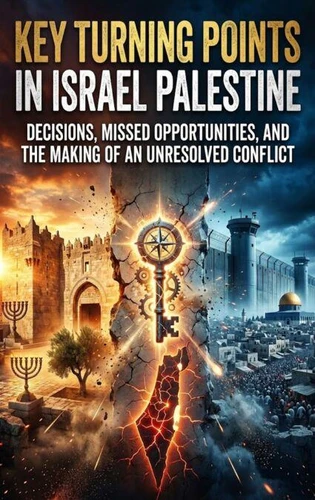
Key Turning Points in Israel Palestine. Decisions, Missed Opportunities, and the Making of an Unresolved Conflict
Par :Formats :
Disponible dans votre compte client Decitre ou Furet du Nord dès validation de votre commande. Le format ePub est :
- Compatible avec une lecture sur My Vivlio (smartphone, tablette, ordinateur)
- Compatible avec une lecture sur liseuses Vivlio
- Pour les liseuses autres que Vivlio, vous devez utiliser le logiciel Adobe Digital Edition. Non compatible avec la lecture sur les liseuses Kindle, Remarkable et Sony
 , qui est-ce ?
Notre partenaire de plateforme de lecture numérique où vous retrouverez l'ensemble de vos ebooks gratuitement
Pour en savoir plus sur nos ebooks, consultez notre aide en ligne ici
C'est si simple ! Lisez votre ebook avec l'app Vivlio sur votre tablette, mobile ou ordinateur :

- Nombre de pages200
- FormatePub
- ISBN978-3-565-27223-5
- EAN9783565272235
- Date de parution25/02/2026
- Protection num.pas de protection
- Taille2 Mo
- Infos supplémentairesepub
- ÉditeurEmphaloz Publishing House
Résumé
Every conflict has its hinges-moments when a different decision, a different agreement, or a different response might have altered the course of history. The Israel-Palestine conflict is defined by such moments, each one layered with competing narratives, geopolitical pressures, and the lived experiences of millions of people caught between competing claims to the same land.
This book traces the pivotal junctures that shaped the conflict from the late Ottoman period through the British Mandate, the 1948 war, the Oslo negotiations, and into the twenty-first century.
Drawing on declassified documents, diplomatic correspondence, and testimony from participants on all sides, it examines the decisions made-and those deliberately avoided-by state actors, international bodies, and local leadership at each critical moment. The focus is not on assigning blame but on understanding causation. How did specific agreements succeed or collapse? What role did external powers play in shaping outcomes on the ground? How did civilian populations experience and respond to each turning point? By grounding analysis in primary sources and historical context, this book offers readers a rigorous, balanced framework for understanding one of the modern world's most contested and consequential conflicts-one that continues to shape international relations, humanitarian law, and regional stability today.
Drawing on declassified documents, diplomatic correspondence, and testimony from participants on all sides, it examines the decisions made-and those deliberately avoided-by state actors, international bodies, and local leadership at each critical moment. The focus is not on assigning blame but on understanding causation. How did specific agreements succeed or collapse? What role did external powers play in shaping outcomes on the ground? How did civilian populations experience and respond to each turning point? By grounding analysis in primary sources and historical context, this book offers readers a rigorous, balanced framework for understanding one of the modern world's most contested and consequential conflicts-one that continues to shape international relations, humanitarian law, and regional stability today.
A propos de Thalia Brookstone




8,99 €