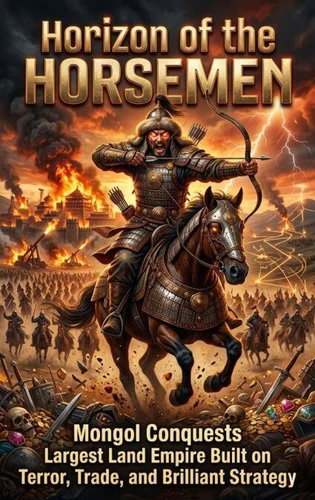
Horizon of the Horsemen. Mongol Conquests Largest Land Empire Built on Terror, Trade, and Brilliant Strategy
Par :Formats :
Disponible dans votre compte client Decitre ou Furet du Nord dès validation de votre commande. Le format ePub est :
- Compatible avec une lecture sur My Vivlio (smartphone, tablette, ordinateur)
- Compatible avec une lecture sur liseuses Vivlio
- Pour les liseuses autres que Vivlio, vous devez utiliser le logiciel Adobe Digital Edition. Non compatible avec la lecture sur les liseuses Kindle, Remarkable et Sony
 , qui est-ce ?
Notre partenaire de plateforme de lecture numérique où vous retrouverez l'ensemble de vos ebooks gratuitement
Pour en savoir plus sur nos ebooks, consultez notre aide en ligne ici
C'est si simple ! Lisez votre ebook avec l'app Vivlio sur votre tablette, mobile ou ordinateur :

- Nombre de pages162
- FormatePub
- ISBN978-3-565-46212-4
- EAN9783565462124
- Date de parution27/05/2026
- Protection num.pas de protection
- Taille2 Mo
- Infos supplémentairesepub
- ÉditeurEmphaloz Publishing House
Résumé
This book traces how Temüjin and his successors forged the largest contiguous land empire in history by fusing steppe warfare, ruthless psychological terror, and shrewd trade-oriented statecraft into a single, self-reinforcing machine of conquest. It shows that the Mongol Empire did not rest on brute force alone, but on a calculated blend of military innovation, communication networks, and the deliberate re-opening of Eurasian trade routes that turned the Silk Road into an imperial lifeline.
By threading together campaigns from China to Hungary, it reveals how a nomadic elite came to connect, and reshape, the entire continent. Terror and psychological warfare form the first pillar of Mongol power: the Mongols systematically used mass executions, the display of terror, and the stark choice of surrender or annihilation to paralyse resistance and make cities yield without prolonged sieges, so that fear often crossed the battlefield before the riders arrived.
The second pillar is strategy and organisation: highly mobile cavalry units, compartmentalised command, and the rapid transmission of orders across enormous distances allowed the Mongols to out-manoeuvre larger, less flexible armies and coordinate campaigns that spanned from the Pacific to the Danube. The third pillar is trade and infrastructure: by securing, protecting, and taxing the Silk Road, the Mongols fostered the Pax Mongolica, enabling unprecedented flows of goods, technologies, and ideas and turning mercantile wealth into the engine that financed further conquest and administration.
By threading together campaigns from China to Hungary, it reveals how a nomadic elite came to connect, and reshape, the entire continent. Terror and psychological warfare form the first pillar of Mongol power: the Mongols systematically used mass executions, the display of terror, and the stark choice of surrender or annihilation to paralyse resistance and make cities yield without prolonged sieges, so that fear often crossed the battlefield before the riders arrived.
The second pillar is strategy and organisation: highly mobile cavalry units, compartmentalised command, and the rapid transmission of orders across enormous distances allowed the Mongols to out-manoeuvre larger, less flexible armies and coordinate campaigns that spanned from the Pacific to the Danube. The third pillar is trade and infrastructure: by securing, protecting, and taxing the Silk Road, the Mongols fostered the Pax Mongolica, enabling unprecedented flows of goods, technologies, and ideas and turning mercantile wealth into the engine that financed further conquest and administration.