A former corporate burnout who rebuilt her life through mindfulness routines, now blending self-help for stress mastery, business coaching on team wellness, and historical analysis of wellness movements in industrial eras.
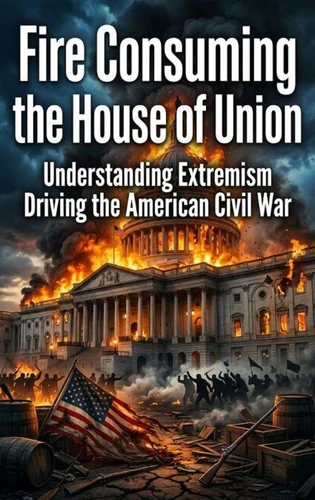
Fire Consuming the House of Union. Understanding Extremism Driving the American Civil War
Par :Formats :
Disponible dans votre compte client Decitre ou Furet du Nord dès validation de votre commande. Le format ePub est :
- Compatible avec une lecture sur My Vivlio (smartphone, tablette, ordinateur)
- Compatible avec une lecture sur liseuses Vivlio
- Pour les liseuses autres que Vivlio, vous devez utiliser le logiciel Adobe Digital Edition. Non compatible avec la lecture sur les liseuses Kindle, Remarkable et Sony
 , qui est-ce ?
Notre partenaire de plateforme de lecture numérique où vous retrouverez l'ensemble de vos ebooks gratuitement
Pour en savoir plus sur nos ebooks, consultez notre aide en ligne ici
C'est si simple ! Lisez votre ebook avec l'app Vivlio sur votre tablette, mobile ou ordinateur :

- Nombre de pages271
- FormatePub
- ISBN978-3-565-40399-8
- EAN9783565403998
- Date de parution11/04/2026
- Protection num.pas de protection
- Taille1 Mo
- Infos supplémentairesepub
- ÉditeurEmphaloz Publishing House
Résumé
Civil wars are rarely started by moderates. The American conflict of 1861-1865 was shaped not by the exhausted compromisers who spent decades trying to hold the republic together, but by the men on both flanks who decided, each for their own reasons, that the centre could no longer hold - and that burning it down was preferable to reform.
On the Southern side, the Fire-Eaters formed the most consequential radical faction in antebellum American politics.
Not a unified party but a loosely aligned network of proslavery extremists - among them Edmund Ruffin, Robert Barnwell Rhett, and William Lowndes Yancey - they had been agitating for Southern secession and independent nationhood since the 1840s, long before the crisis of 1860 gave them the opening they required. Their genius was strategic rather than military: they understood that moderate Northern antislavery sentiment, left alone, would never force a confrontation, but that a sequence of manufactured crises - Bleeding Kansas, the caning of Senator Charles Sumner, the spectre of John Brown's raids - could transform Southern anxiety into a demand for separation.
Yancey personally engineered the walkout at the 1860 Charleston Democratic convention that shattered the party and guaranteed Lincoln's electoral victory without a single Southern state. Louis T. Wigfall then actively encouraged the attack on Fort Sumter, calculating that it would force the Upper South off the fence and into the Confederacy - a calculation that proved precisely correct.
Not a unified party but a loosely aligned network of proslavery extremists - among them Edmund Ruffin, Robert Barnwell Rhett, and William Lowndes Yancey - they had been agitating for Southern secession and independent nationhood since the 1840s, long before the crisis of 1860 gave them the opening they required. Their genius was strategic rather than military: they understood that moderate Northern antislavery sentiment, left alone, would never force a confrontation, but that a sequence of manufactured crises - Bleeding Kansas, the caning of Senator Charles Sumner, the spectre of John Brown's raids - could transform Southern anxiety into a demand for separation.
Yancey personally engineered the walkout at the 1860 Charleston Democratic convention that shattered the party and guaranteed Lincoln's electoral victory without a single Southern state. Louis T. Wigfall then actively encouraged the attack on Fort Sumter, calculating that it would force the Upper South off the fence and into the Confederacy - a calculation that proved precisely correct.
A propos de Veda Grant
24,99 €
9,99 €