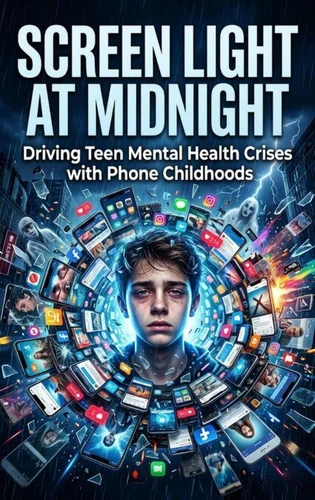
Screen Light at Midnight. Driving Teen Mental Health Crises with Phone Childhoods
Par :Formats :
Disponible dans votre compte client Decitre ou Furet du Nord dès validation de votre commande. Le format ePub est :
- Compatible avec une lecture sur My Vivlio (smartphone, tablette, ordinateur)
- Compatible avec une lecture sur liseuses Vivlio
- Pour les liseuses autres que Vivlio, vous devez utiliser le logiciel Adobe Digital Edition. Non compatible avec la lecture sur les liseuses Kindle, Remarkable et Sony
 , qui est-ce ?
Notre partenaire de plateforme de lecture numérique où vous retrouverez l'ensemble de vos ebooks gratuitement
Pour en savoir plus sur nos ebooks, consultez notre aide en ligne ici
C'est si simple ! Lisez votre ebook avec l'app Vivlio sur votre tablette, mobile ou ordinateur :

- Nombre de pages222
- FormatePub
- ISBN978-3-565-41063-7
- EAN9783565410637
- Date de parution14/04/2026
- Protection num.pas de protection
- Taille2 Mo
- Infos supplémentairesepub
- ÉditeurEmphaloz Publishing House
Résumé
Something measurable began to break in Western adolescence around 2012. From 2009 to 2017, rates of depression among teenagers aged 14 to 17 in the United States jumped more than 60%, and emergency-room visits for self-harm and suicidal ideation in this age group rose sharply alongside that curve. The year 2012 was not arbitrary - it marked the moment when smartphone ownership among American teenagers crossed 50%, and social media became a daily, ambient environment rather than an occasional destination.
Psychologist Jean Twenge, studying the iGen cohort born between 1995 and 2005, argued that much of this deterioration "can be traced to their phones" - and the decade of research that followed has assembled a case that is difficult to dismiss. The mechanism is not simply time. It is architecture. Longitudinal cohort studies tracking children aged 9 to 12 found that within-person increases in social media use were prospectively associated with greater depressive symptoms one year later - a temporal ordering that suggests causation rather than mere correlation, and not merely a pattern in which depressed children seek out screens.
The effects are sharpest among girls, for whom social media introduces a particular compound of social comparison, appearance anxiety, cyberbullying, and the chronic performance of an identity assembled for an audience that never sleeps. Evidence from cross-sectional, longitudinal, and empirical studies consistently implicates smartphone and social media use in the rise of mental distress, self-injurious behaviour, and suicidality among youth - with a dose-response relationship: more use, more damage.
Psychologist Jean Twenge, studying the iGen cohort born between 1995 and 2005, argued that much of this deterioration "can be traced to their phones" - and the decade of research that followed has assembled a case that is difficult to dismiss. The mechanism is not simply time. It is architecture. Longitudinal cohort studies tracking children aged 9 to 12 found that within-person increases in social media use were prospectively associated with greater depressive symptoms one year later - a temporal ordering that suggests causation rather than mere correlation, and not merely a pattern in which depressed children seek out screens.
The effects are sharpest among girls, for whom social media introduces a particular compound of social comparison, appearance anxiety, cyberbullying, and the chronic performance of an identity assembled for an audience that never sleeps. Evidence from cross-sectional, longitudinal, and empirical studies consistently implicates smartphone and social media use in the rise of mental distress, self-injurious behaviour, and suicidality among youth - with a dose-response relationship: more use, more damage.
A propos de Veda Grant



24,99 €





9,99 €