Specializes in historical investigations covering political intrigue, exploration, and forgotten turning points in world history.
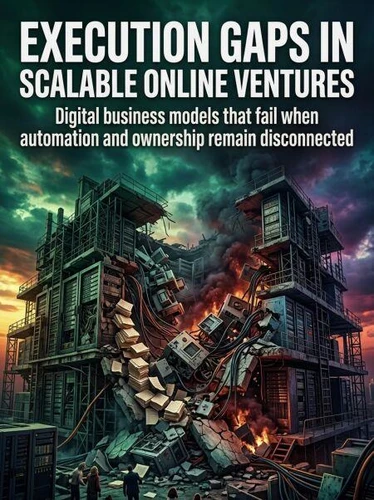
Execution Gaps in Scalable Online Ventures. Digital business models that fail when automation and ownership remain disconnected
Par :Formats :
Disponible dans votre compte client Decitre ou Furet du Nord dès validation de votre commande. Le format ePub est :
- Compatible avec une lecture sur My Vivlio (smartphone, tablette, ordinateur)
- Compatible avec une lecture sur liseuses Vivlio
- Pour les liseuses autres que Vivlio, vous devez utiliser le logiciel Adobe Digital Edition. Non compatible avec la lecture sur les liseuses Kindle, Remarkable et Sony
 , qui est-ce ?
Notre partenaire de plateforme de lecture numérique où vous retrouverez l'ensemble de vos ebooks gratuitement
Pour en savoir plus sur nos ebooks, consultez notre aide en ligne ici
C'est si simple ! Lisez votre ebook avec l'app Vivlio sur votre tablette, mobile ou ordinateur :

- Nombre de pages221
- FormatePub
- ISBN978-3-565-48339-6
- EAN9783565483396
- Date de parution07/06/2026
- Protection num.pas de protection
- Taille1 Mo
- Infos supplémentairesepub
- ÉditeurEmphaloz Publishing House
Résumé
Digital business models promise flexibility, leverage, and scalable revenue. Yet many online ventures reach a ceiling when founder effort becomes the primary operating system. The issue is not opportunity. It is execution architecture.
This book analyzes seven online business categories through the lens of operational scalability. Instead of emphasizing inspiration or entrepreneurial narratives, it investigates the systems required to sustain digital business models without constant intervention.
Readers explore content networks, digital products, affiliate operations, subscription assets, online education platforms, community-driven businesses, and service ecosystems enhanced through automation.
Each model is evaluated according to ownership, distribution control, revenue durability, and operational complexity. Special attention is given to automation frameworks, customer acquisition economics, asset creation cycles, and dependency risks created by external platforms. The objective is to understand where scalable businesses gain leverage and where they quietly lose it. The discussion extends beyond startup enthusiasm into the realities of maintaining profitable systems over time.
Sustainable growth depends less on innovation alone and more on repeatable structures capable of surviving market shifts. Across Europe, founders increasingly operate within mature digital markets where efficiency, compliance, and customer trust influence outcomes. Businesses built on strong execution architecture may hold advantages that growth metrics alone cannot reveal.
Each model is evaluated according to ownership, distribution control, revenue durability, and operational complexity. Special attention is given to automation frameworks, customer acquisition economics, asset creation cycles, and dependency risks created by external platforms. The objective is to understand where scalable businesses gain leverage and where they quietly lose it. The discussion extends beyond startup enthusiasm into the realities of maintaining profitable systems over time.
Sustainable growth depends less on innovation alone and more on repeatable structures capable of surviving market shifts. Across Europe, founders increasingly operate within mature digital markets where efficiency, compliance, and customer trust influence outcomes. Businesses built on strong execution architecture may hold advantages that growth metrics alone cannot reveal.