Specializes in historical investigations covering political intrigue, exploration, and forgotten turning points in world history.
Nouveauté
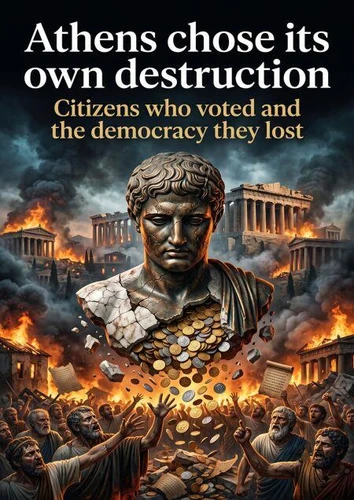
Athens chose its own destruction. Citizens who voted and the democracy they lost
Par :Formats :
Disponible dans votre compte client Decitre ou Furet du Nord dès validation de votre commande. Le format ePub est :
- Compatible avec une lecture sur My Vivlio (smartphone, tablette, ordinateur)
- Compatible avec une lecture sur liseuses Vivlio
- Pour les liseuses autres que Vivlio, vous devez utiliser le logiciel Adobe Digital Edition. Non compatible avec la lecture sur les liseuses Kindle, Remarkable et Sony
 , qui est-ce ?
Notre partenaire de plateforme de lecture numérique où vous retrouverez l'ensemble de vos ebooks gratuitement
Pour en savoir plus sur nos ebooks, consultez notre aide en ligne ici
C'est si simple ! Lisez votre ebook avec l'app Vivlio sur votre tablette, mobile ou ordinateur :

- Nombre de pages148
- FormatePub
- ISBN978-3-565-55291-7
- EAN9783565552917
- Date de parution09/07/2026
- Protection num.pas de protection
- Taille1 Mo
- Infos supplémentairesepub
- ÉditeurEmphaloz Publishing House
Résumé
Athens gave the world democracy, but not as an ideal. It was a fragile, human invention built on the labor of citizens who debated, voted, and judged one another. This book examines the messy mechanics of Athenian self-rule-the assemblies where farmers and merchants decided war, the courts where citizens prosecuted their own leaders, and the taxes that funded the fleet. It shows how democracy worked not because of philosophers, but because of ordinary people who showed up.
The system thrived on participation and nearly collapsed under its own ambition, from the Sicilian expedition to the trial of Socrates. By tracing the practical demands of citizenship-military service, jury duty, public speaking-this account reveals ancient Greek democracy as a lived experiment, not a textbook theory. Its legacy is not a blueprint, but a warning: freedom requires effort, and effort can be exhausted.
For readers of European history and the history of democracy, this is a story about what it costs to rule yourself.
The system thrived on participation and nearly collapsed under its own ambition, from the Sicilian expedition to the trial of Socrates. By tracing the practical demands of citizenship-military service, jury duty, public speaking-this account reveals ancient Greek democracy as a lived experiment, not a textbook theory. Its legacy is not a blueprint, but a warning: freedom requires effort, and effort can be exhausted.
For readers of European history and the history of democracy, this is a story about what it costs to rule yourself.