OFFRE LISEUSES
Une liseuse achetée = une housse offerte* jusqu'au 21 juin
- Accueil /
- Nathaniel Crosswyn
Nathaniel Crosswyn

Dernière sortie
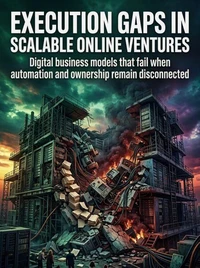
Execution Gaps in Scalable Online Ventures
Digital business models promise flexibility, leverage, and scalable revenue. Yet many online ventures reach a ceiling when founder effort becomes the primary operating system. The issue is not opportunity. It is execution architecture.
This book analyzes seven online business categories through the lens of operational scalability. Instead of emphasizing inspiration or entrepreneurial narratives, it investigates the systems required to sustain digital business models without constant intervention.
Readers explore content networks, digital products, affiliate operations, subscription assets, online education platforms, community-driven businesses, and service ecosystems enhanced through automation.
Each model is evaluated according to ownership, distribution control, revenue durability, and operational complexity. Special attention is given to automation frameworks, customer acquisition economics, asset creation cycles, and dependency risks created by external platforms. The objective is to understand where scalable businesses gain leverage and where they quietly lose it. The discussion extends beyond startup enthusiasm into the realities of maintaining profitable systems over time.
Sustainable growth depends less on innovation alone and more on repeatable structures capable of surviving market shifts. Across Europe, founders increasingly operate within mature digital markets where efficiency, compliance, and customer trust influence outcomes. Businesses built on strong execution architecture may hold advantages that growth metrics alone cannot reveal.
Each model is evaluated according to ownership, distribution control, revenue durability, and operational complexity. Special attention is given to automation frameworks, customer acquisition economics, asset creation cycles, and dependency risks created by external platforms. The objective is to understand where scalable businesses gain leverage and where they quietly lose it. The discussion extends beyond startup enthusiasm into the realities of maintaining profitable systems over time.
Sustainable growth depends less on innovation alone and more on repeatable structures capable of surviving market shifts. Across Europe, founders increasingly operate within mature digital markets where efficiency, compliance, and customer trust influence outcomes. Businesses built on strong execution architecture may hold advantages that growth metrics alone cannot reveal.
Digital business models promise flexibility, leverage, and scalable revenue. Yet many online ventures reach a ceiling when founder effort becomes the primary operating system. The issue is not opportunity. It is execution architecture.
This book analyzes seven online business categories through the lens of operational scalability. Instead of emphasizing inspiration or entrepreneurial narratives, it investigates the systems required to sustain digital business models without constant intervention.
Readers explore content networks, digital products, affiliate operations, subscription assets, online education platforms, community-driven businesses, and service ecosystems enhanced through automation.
Each model is evaluated according to ownership, distribution control, revenue durability, and operational complexity. Special attention is given to automation frameworks, customer acquisition economics, asset creation cycles, and dependency risks created by external platforms. The objective is to understand where scalable businesses gain leverage and where they quietly lose it. The discussion extends beyond startup enthusiasm into the realities of maintaining profitable systems over time.
Sustainable growth depends less on innovation alone and more on repeatable structures capable of surviving market shifts. Across Europe, founders increasingly operate within mature digital markets where efficiency, compliance, and customer trust influence outcomes. Businesses built on strong execution architecture may hold advantages that growth metrics alone cannot reveal.
Each model is evaluated according to ownership, distribution control, revenue durability, and operational complexity. Special attention is given to automation frameworks, customer acquisition economics, asset creation cycles, and dependency risks created by external platforms. The objective is to understand where scalable businesses gain leverage and where they quietly lose it. The discussion extends beyond startup enthusiasm into the realities of maintaining profitable systems over time.
Sustainable growth depends less on innovation alone and more on repeatable structures capable of surviving market shifts. Across Europe, founders increasingly operate within mature digital markets where efficiency, compliance, and customer trust influence outcomes. Businesses built on strong execution architecture may hold advantages that growth metrics alone cannot reveal.
Les livres de Nathaniel Crosswyn
Nouveauté

Not Everything Gentle Is Care. When wellness becomes performance and burnout asks for honest limits
Nathaniel Crosswyn
E-book
9,99 €
Nouveauté

Nouveauté

9,99 €