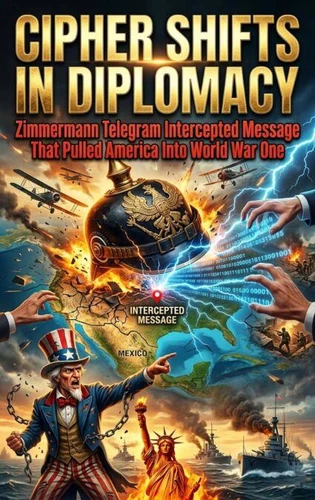
Cipher Shifts in Diplomacy. Zimmermann Telegram Intercepted Message That Pulled America Into World War One
Par :Formats :
Disponible dans votre compte client Decitre ou Furet du Nord dès validation de votre commande. Le format ePub est :
- Compatible avec une lecture sur My Vivlio (smartphone, tablette, ordinateur)
- Compatible avec une lecture sur liseuses Vivlio
- Pour les liseuses autres que Vivlio, vous devez utiliser le logiciel Adobe Digital Edition. Non compatible avec la lecture sur les liseuses Kindle, Remarkable et Sony
 , qui est-ce ?
Notre partenaire de plateforme de lecture numérique où vous retrouverez l'ensemble de vos ebooks gratuitement
Pour en savoir plus sur nos ebooks, consultez notre aide en ligne ici
C'est si simple ! Lisez votre ebook avec l'app Vivlio sur votre tablette, mobile ou ordinateur :

- Nombre de pages179
- FormatePub
- ISBN978-3-565-44875-3
- EAN9783565448753
- Date de parution18/05/2026
- Protection num.pas de protection
- Taille2 Mo
- Infos supplémentairesepub
- ÉditeurEmphaloz Publishing House
Résumé
The first mechanism examined is the intelligence interception and decryption pipeline, which transformed a routine diplomatic cable into actionable strategic knowledge. British Room?40's ability to decrypt the telegram relied on captured codebooks and the reuse of older German ciphers, demonstrating how lapses in cryptographic hygiene can expose sensitive communications to adversaries. This created a feedback loop where the sender's assumption of code security was undermined, altering the cost-benefit calculus of using covert channels for alliance proposals.
The second mechanism concerns decision-making hierarchies within the German Foreign Office and the U. S. State Department. Zimmermann's dispatch assumed that transmission via neutral embassies would preserve secrecy, yet the U. S. government's role as a neutral conduit created a structural vulnerability that British exploitation turned into a diplomatic lever. The resulting need to reroute sensitive traffic through compromised pathways forced German diplomats to operate under heightened scrutiny, slowing the speed of secret negotiations.
The third mechanism involves incentive structures for alliance formation. The telegram's promise of territorial restitution to Mexico was designed to alter Mexico's strategic incentives, but its exposure changed the perceived risks for both Germany and Mexico, revealing how the credibility of secret pledges depends on the inviolability of the communication medium used to convey them. When that medium proved penetrable, the incentive to accept such offers diminished, illustrating how information security directly influences alliance viability.
The second mechanism concerns decision-making hierarchies within the German Foreign Office and the U. S. State Department. Zimmermann's dispatch assumed that transmission via neutral embassies would preserve secrecy, yet the U. S. government's role as a neutral conduit created a structural vulnerability that British exploitation turned into a diplomatic lever. The resulting need to reroute sensitive traffic through compromised pathways forced German diplomats to operate under heightened scrutiny, slowing the speed of secret negotiations.
The third mechanism involves incentive structures for alliance formation. The telegram's promise of territorial restitution to Mexico was designed to alter Mexico's strategic incentives, but its exposure changed the perceived risks for both Germany and Mexico, revealing how the credibility of secret pledges depends on the inviolability of the communication medium used to convey them. When that medium proved penetrable, the incentive to accept such offers diminished, illustrating how information security directly influences alliance viability.