She creates books that connect historical insight, business thinking, and personal growth into clear, useful ideas.
Nouveauté
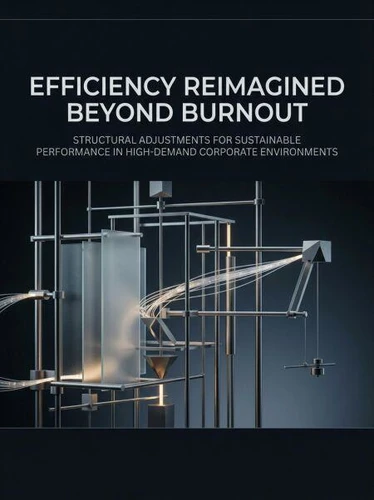
Efficiency Reimagined Beyond Burnout. Structural Adjustments for Sustainable Performance in High-Demand Corporate Environments
Par :Formats :
Disponible dans votre compte client Decitre ou Furet du Nord dès validation de votre commande. Le format ePub est :
- Compatible avec une lecture sur My Vivlio (smartphone, tablette, ordinateur)
- Compatible avec une lecture sur liseuses Vivlio
- Pour les liseuses autres que Vivlio, vous devez utiliser le logiciel Adobe Digital Edition. Non compatible avec la lecture sur les liseuses Kindle, Remarkable et Sony
 , qui est-ce ?
Notre partenaire de plateforme de lecture numérique où vous retrouverez l'ensemble de vos ebooks gratuitement
Pour en savoir plus sur nos ebooks, consultez notre aide en ligne ici
C'est si simple ! Lisez votre ebook avec l'app Vivlio sur votre tablette, mobile ou ordinateur :

- Nombre de pages451
- FormatePub
- ISBN978-3-565-60215-5
- EAN9783565602155
- Date de parution30/07/2026
- Protection num.pas de protection
- Taille797 Ko
- Infos supplémentairesepub
- ÉditeurEmphaloz Publishing House
Résumé
Corporate environments demand constant output, yet traditional efficiency models accelerate burnout rather than prevent it. The tension between productivity expectations and human capacity has reached a structural breaking point, requiring new frameworks that separate activity from impact. This book examines how organizations conflate busyness with effectiveness, creating systems that reward visible effort over measurable outcomes.
It explores three operational mechanisms: task filtering based on strategic alignment rather than urgency, energy allocation across cognitive load cycles, and boundary enforcement within role definitions. Each mechanism addresses a specific failure mode in modern work design-where reactive workflows replace intentional prioritization, where collaboration tools fragment attention, and where availability culture erodes recovery time.
The analysis reveals how effectiveness emerges from constraint design rather than capacity expansion. For European markets where work-life integration policies coexist with performance intensity, the book offers a structural lens on sustainable productivity. It positions effectiveness not as personal optimization but as organizational architecture-one that must account for human limitations as design parameters rather than obstacles to overcome.
It explores three operational mechanisms: task filtering based on strategic alignment rather than urgency, energy allocation across cognitive load cycles, and boundary enforcement within role definitions. Each mechanism addresses a specific failure mode in modern work design-where reactive workflows replace intentional prioritization, where collaboration tools fragment attention, and where availability culture erodes recovery time.
The analysis reveals how effectiveness emerges from constraint design rather than capacity expansion. For European markets where work-life integration policies coexist with performance intensity, the book offers a structural lens on sustainable productivity. It positions effectiveness not as personal optimization but as organizational architecture-one that must account for human limitations as design parameters rather than obstacles to overcome.