The deeper Early and Christopher travel into the Core, the less reliable memory becomes. Names shift. Authorship changes hands. Events that should be fixed begin rewriting themselves around whichever history is currently strongest. A life can disappear because another version of the past says it never happened. A wound can belong to someone else. A room can remember a conversation no one recalls having.
The manuscript is no longer merely recording reality. It is deciding which reality deserves to survive. Christopher searches the shifting histories for the first writer, hoping that the oldest signature will reveal the truth. Instead he finds erased names, unfinished warnings, pages that contradict one another, and the same impossible room repeating across multiple versions of the past. Inside that room waits a single chair turned toward a blank wall.
No matter which history they enter, the room is there. No matter who supposedly created the Core, someone has already been waiting. One door remembers a world where Christopher never existed. Another remembers a world where Early never escaped. Another suggests that neither man was first. The final door refuses to show what waits behind it. As the doors multiply, the relationship between creator and creation becomes harder to define.
Christopher can no longer assume that writing the story means he owns its beginning. Early can no longer trust that surviving the story means he remembers what truly happened. The Core offers them proof, then replaces it. It gives them answers, then reveals the memories attached to those answers may have been manufactured. Every discovery makes the universe more complete and the truth more unstable.
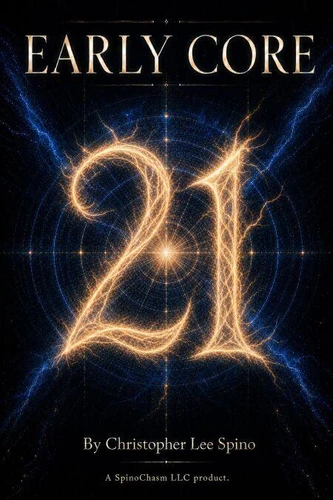
EARLY CORE 21 continues the hidden metafictional architecture beneath the SpinoChasm universe, moving through the spaces where authorship, memory, identity, and reality collide. The Core is not simply a place beneath the stories. It is a living structure capable of preserving discarded possibilities and forcing them back into the world. Forgotten drafts become histories. Abandoned endings become alternate lives.
Unwritten choices begin demanding recognition. Early has survived places that wanted to keep him. Now he faces something more dangerous: a universe that can change what survival meant. Christopher has written worlds before. Now he must confront the possibility that the world remembers a writer who came before him. Together they move through conflicting origins, manufactured memories, erased authors, impossible rooms, and twenty-one doors that cannot all be telling the truth.
Their task is not merely to find the correct history. They must determine whether a single correct history still exists-and what will happen to every living version of the story when one past is chosen over the others. Blending surreal horror, dark fantasy, supernatural mystery, psychological fantasy, and metafiction, EARLY CORE 21 turns the question of origin into a trap. It explores unstable identity, competing realities, authorship without certainty, memory as architecture, and the terrifying possibility that a story can remember more versions of you than you remember of yourself.
The Core has twenty-one doors. Twenty histories are lying. One remembers the truth.
The deeper Early and Christopher travel into the Core, the less reliable memory becomes. Names shift. Authorship changes hands. Events that should be fixed begin rewriting themselves around whichever history is currently strongest. A life can disappear because another version of the past says it never happened. A wound can belong to someone else. A room can remember a conversation no one recalls having.
The manuscript is no longer merely recording reality. It is deciding which reality deserves to survive. Christopher searches the shifting histories for the first writer, hoping that the oldest signature will reveal the truth. Instead he finds erased names, unfinished warnings, pages that contradict one another, and the same impossible room repeating across multiple versions of the past. Inside that room waits a single chair turned toward a blank wall.
No matter which history they enter, the room is there. No matter who supposedly created the Core, someone has already been waiting. One door remembers a world where Christopher never existed. Another remembers a world where Early never escaped. Another suggests that neither man was first. The final door refuses to show what waits behind it. As the doors multiply, the relationship between creator and creation becomes harder to define.
Christopher can no longer assume that writing the story means he owns its beginning. Early can no longer trust that surviving the story means he remembers what truly happened. The Core offers them proof, then replaces it. It gives them answers, then reveals the memories attached to those answers may have been manufactured. Every discovery makes the universe more complete and the truth more unstable.
EARLY CORE 21 continues the hidden metafictional architecture beneath the SpinoChasm universe, moving through the spaces where authorship, memory, identity, and reality collide. The Core is not simply a place beneath the stories. It is a living structure capable of preserving discarded possibilities and forcing them back into the world. Forgotten drafts become histories. Abandoned endings become alternate lives.
Unwritten choices begin demanding recognition. Early has survived places that wanted to keep him. Now he faces something more dangerous: a universe that can change what survival meant. Christopher has written worlds before. Now he must confront the possibility that the world remembers a writer who came before him. Together they move through conflicting origins, manufactured memories, erased authors, impossible rooms, and twenty-one doors that cannot all be telling the truth.
Their task is not merely to find the correct history. They must determine whether a single correct history still exists-and what will happen to every living version of the story when one past is chosen over the others. Blending surreal horror, dark fantasy, supernatural mystery, psychological fantasy, and metafiction, EARLY CORE 21 turns the question of origin into a trap. It explores unstable identity, competing realities, authorship without certainty, memory as architecture, and the terrifying possibility that a story can remember more versions of you than you remember of yourself.
The Core has twenty-one doors. Twenty histories are lying. One remembers the truth.