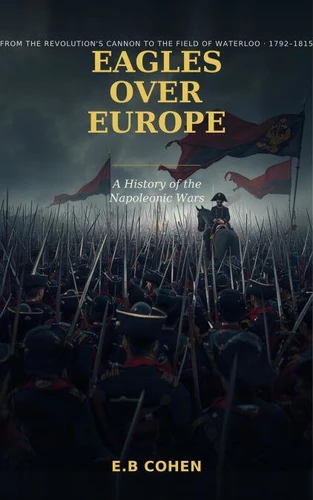
In 1792 the armies of a revolution marched out to defend a republic; twenty-three years later, after a war that had swept from Lisbon to Moscow and from the Nile to the North Sea, a beaten emperor sat on a rock in the South Atlantic and the kings of Europe redrew their continent around his absence. Between those two moments lies one of the most extraordinary and terrible stories in history. This is the whole arc of the Napoleonic Wars, told as a single narrative: the improvised citizen-armies the French Revolution flung against the monarchies of Europe; the meteoric rise of Napoleon Bonaparte from unknown artillery officer to Emperor of the French; the dazzling victories of Ulm and Austerlitz and Jena that made him master of a continent; the long bleeding "ulcer" of the war in Spain; the six hundred thousand men who marched into Russia and the few thousand who staggered out; the fall of the eagle at Leipzig, the hundred-day resurrection, and the last afternoon at Waterloo.
Drawing on the standard scholarship and the voices of those who were there - marshals and privates, admirals and diplomats, the women of the home fronts and the peasants in the path of the armies - E. B Cohen tells the story of the wars that killed millions, toppled a thousand-year empire, spread a code of laws and an idea of the nation across the world, and shaped the century that followed. It is the history of how the modern world was forged in gunpowder and ambition, and of the strange, brilliant, and ruinous man at its center.
In 1792 the armies of a revolution marched out to defend a republic; twenty-three years later, after a war that had swept from Lisbon to Moscow and from the Nile to the North Sea, a beaten emperor sat on a rock in the South Atlantic and the kings of Europe redrew their continent around his absence. Between those two moments lies one of the most extraordinary and terrible stories in history. This is the whole arc of the Napoleonic Wars, told as a single narrative: the improvised citizen-armies the French Revolution flung against the monarchies of Europe; the meteoric rise of Napoleon Bonaparte from unknown artillery officer to Emperor of the French; the dazzling victories of Ulm and Austerlitz and Jena that made him master of a continent; the long bleeding "ulcer" of the war in Spain; the six hundred thousand men who marched into Russia and the few thousand who staggered out; the fall of the eagle at Leipzig, the hundred-day resurrection, and the last afternoon at Waterloo.
Drawing on the standard scholarship and the voices of those who were there - marshals and privates, admirals and diplomats, the women of the home fronts and the peasants in the path of the armies - E. B Cohen tells the story of the wars that killed millions, toppled a thousand-year empire, spread a code of laws and an idea of the nation across the world, and shaped the century that followed. It is the history of how the modern world was forged in gunpowder and ambition, and of the strange, brilliant, and ruinous man at its center.

 , qui est-ce ?