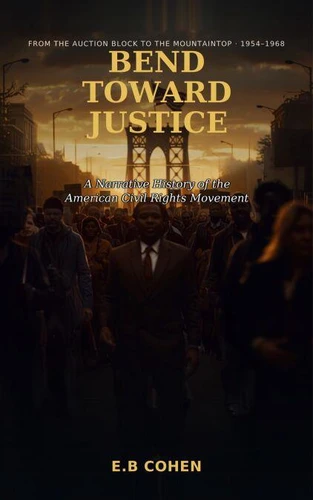
In 1954 the Supreme Court declared that separate could never be equal, and a struggle that had smoldered since the auction block burst into open flame. Over the next fourteen years, ordinary Black Americans and their allies would bring down the legal edifice of American apartheid - not with armies, but with the disciplined, dangerous courage of people who refused, any longer, to accept the world as it was.
This is the whole arc of the American civil rights movement, told as a single narrative: the roots of slavery and Jim Crow; the murder of Emmett Till and the seamstress who would not move; the young preacher who became the voice of a generation; the sit-ins and the Freedom Rides; the children of Birmingham and the fire hoses; the dream proclaimed at the Lincoln Memorial and the bomb that killed four girls; the longest filibuster and the great laws that followed; the blood on the bridge at Selma; the fracture of Black Power and the rise of Malcolm X; and the last radical years of Martin Luther King Jr., from his stand against the war to the balcony in Memphis where he fell.
Drawing on the standard scholarship and the voices of those who were there - the organizers and the martyrs, the sharecroppers and the students, the women too often written out of the story - E. B Cohen tells the movement whole: its triumphs and its unfinished business, its dream and its reckoning, its heroism and its cost. It is the story of how a nation was forced to confront the gap between its promises and its practice, and of the ordinary people who bent the arc, at terrible cost, a little closer to justice.
In 1954 the Supreme Court declared that separate could never be equal, and a struggle that had smoldered since the auction block burst into open flame. Over the next fourteen years, ordinary Black Americans and their allies would bring down the legal edifice of American apartheid - not with armies, but with the disciplined, dangerous courage of people who refused, any longer, to accept the world as it was.
This is the whole arc of the American civil rights movement, told as a single narrative: the roots of slavery and Jim Crow; the murder of Emmett Till and the seamstress who would not move; the young preacher who became the voice of a generation; the sit-ins and the Freedom Rides; the children of Birmingham and the fire hoses; the dream proclaimed at the Lincoln Memorial and the bomb that killed four girls; the longest filibuster and the great laws that followed; the blood on the bridge at Selma; the fracture of Black Power and the rise of Malcolm X; and the last radical years of Martin Luther King Jr., from his stand against the war to the balcony in Memphis where he fell.
Drawing on the standard scholarship and the voices of those who were there - the organizers and the martyrs, the sharecroppers and the students, the women too often written out of the story - E. B Cohen tells the movement whole: its triumphs and its unfinished business, its dream and its reckoning, its heroism and its cost. It is the story of how a nation was forced to confront the gap between its promises and its practice, and of the ordinary people who bent the arc, at terrible cost, a little closer to justice.

 , qui est-ce ?