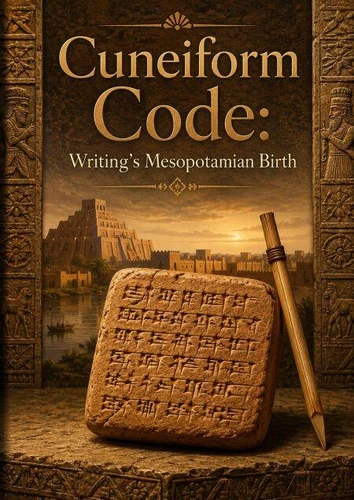
Cuneiform Code: Writing’s Mesopotamian Birth
Par :Formats :
Disponible dans votre compte client Decitre ou Furet du Nord dès validation de votre commande. Le format ePub est :
- Compatible avec une lecture sur My Vivlio (smartphone, tablette, ordinateur)
- Compatible avec une lecture sur liseuses Vivlio
- Pour les liseuses autres que Vivlio, vous devez utiliser le logiciel Adobe Digital Edition. Non compatible avec la lecture sur les liseuses Kindle, Remarkable et Sony
 , qui est-ce ?
Notre partenaire de plateforme de lecture numérique où vous retrouverez l'ensemble de vos ebooks gratuitement
Pour en savoir plus sur nos ebooks, consultez notre aide en ligne ici
C'est si simple ! Lisez votre ebook avec l'app Vivlio sur votre tablette, mobile ou ordinateur :

- FormatePub
- ISBN8235554979
- EAN9798235554979
- Date de parution18/05/2026
- Protection num.pas de protection
- Infos supplémentairesepub
- ÉditeurIoakim Ioakim
Résumé
Cuneiform Code: Writing's Mesopotamian Birth is a richly written journey into one of humanity's greatest inventions: the birth of writing in ancient Mesopotamia. Set in the fertile land between the Tigris and Euphrates rivers, this book explores how the earliest marks on clay slowly developed into cuneiform, the wedge-shaped script that opened the first great age of recorded civilization. It tells the story of how ordinary practical needs-counting grain, recording sheep, managing workers, measuring fields, storing offerings, and preserving trade agreements-became the foundation of written language.
The book begins with the landscape of Mesopotamia, where rivers, canals, temples, storehouses, and growing cities created the need for reliable records. It explains how clay tokens, counting systems, pictographs, and symbolic marks gradually transformed into a complete writing system. Through vivid bookish language, the reader is shown how clay became the first page, the reed stylus became the first pen, and the wedge-shaped mark became a powerful carrier of memory.
This book also highlights the important role of scribes, the trained guardians of the cuneiform code. In a world where literacy was rare, scribes held the power to record law, economy, religion, royal authority, scholarship, and daily life. Their tablets preserved contracts, letters, ration lists, school exercises, myths, prayers, medical knowledge, astronomical observations, and the voices of kings and common people alike.
Cuneiform Code follows the expansion of writing from Sumerian cities to Akkadian kingdoms and later empires, showing how cuneiform became a script of administration, diplomacy, literature, and power. It examines how rulers used writing to proclaim authority, how laws were fixed in clay, how merchants communicated across distance, and how families protected property and inheritance through written documents.
The book gives special attention to the literary and sacred world of Mesopotamia. It explores myths, epics, hymns, laments, flood stories, and the timeless Epic of Gilgamesh, revealing how cuneiform preserved humanity's earliest reflections on friendship, death, kingship, grief, destiny, and the search for meaning. It also presents Mesopotamian scholarship, including mathematics, astronomy, medicine, omens, calendars, and libraries, showing how written knowledge became cumulative across generations.
In its later chapters, the book considers the survival, decline, and legacy of cuneiform. Although alphabetic scripts eventually replaced it, cuneiform's influence remained enormous. It gave humanity some of the earliest archives, legal documents, scientific records, literary masterpieces, and written memories of everyday life. This book is ideal for readers interested in ancient history, Mesopotamian civilization, archaeology, writing systems, early literature, law, religion, and the origins of human knowledge.
More than a study of an ancient script, Cuneiform Code: Writing's Mesopotamian Birth is a powerful exploration of how civilization learned to remember, organize, imagine, and speak across time.
The book begins with the landscape of Mesopotamia, where rivers, canals, temples, storehouses, and growing cities created the need for reliable records. It explains how clay tokens, counting systems, pictographs, and symbolic marks gradually transformed into a complete writing system. Through vivid bookish language, the reader is shown how clay became the first page, the reed stylus became the first pen, and the wedge-shaped mark became a powerful carrier of memory.
This book also highlights the important role of scribes, the trained guardians of the cuneiform code. In a world where literacy was rare, scribes held the power to record law, economy, religion, royal authority, scholarship, and daily life. Their tablets preserved contracts, letters, ration lists, school exercises, myths, prayers, medical knowledge, astronomical observations, and the voices of kings and common people alike.
Cuneiform Code follows the expansion of writing from Sumerian cities to Akkadian kingdoms and later empires, showing how cuneiform became a script of administration, diplomacy, literature, and power. It examines how rulers used writing to proclaim authority, how laws were fixed in clay, how merchants communicated across distance, and how families protected property and inheritance through written documents.
The book gives special attention to the literary and sacred world of Mesopotamia. It explores myths, epics, hymns, laments, flood stories, and the timeless Epic of Gilgamesh, revealing how cuneiform preserved humanity's earliest reflections on friendship, death, kingship, grief, destiny, and the search for meaning. It also presents Mesopotamian scholarship, including mathematics, astronomy, medicine, omens, calendars, and libraries, showing how written knowledge became cumulative across generations.
In its later chapters, the book considers the survival, decline, and legacy of cuneiform. Although alphabetic scripts eventually replaced it, cuneiform's influence remained enormous. It gave humanity some of the earliest archives, legal documents, scientific records, literary masterpieces, and written memories of everyday life. This book is ideal for readers interested in ancient history, Mesopotamian civilization, archaeology, writing systems, early literature, law, religion, and the origins of human knowledge.
More than a study of an ancient script, Cuneiform Code: Writing's Mesopotamian Birth is a powerful exploration of how civilization learned to remember, organize, imagine, and speak across time.
A propos de Dilip Kumar Agrawal

2,99 €

2,99 €

2,99 €

2,99 €

2,99 €



2,99 €

2,99 €

2,99 €

2,99 €

2,99 €

2,99 €
2,99 €