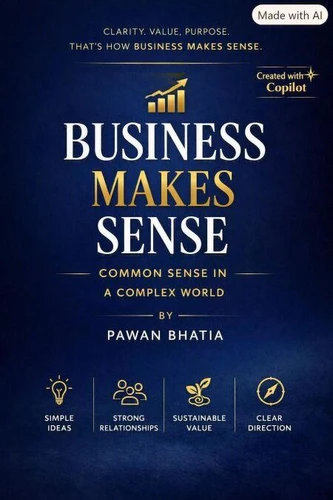
Business Makes Sense: Common Sense in a Complex WorldBy Pawan Bhatia---EXECUTIVE SUMMARYBusiness Makes Sense is a manifesto for clarity in an increasingly complex business world. Drawing on over two decades of experience as an entrepreneur, advisor, and board member, Pawan Bhatia argues that the most successful organizations are not those with the most sophisticated frameworks or largest budgets, but those that refuse to let sophistication substitute for clarity.
The book opens with a compelling premise: most business failure is not a failure of intelligence or effort, but a failure of sense-a slow, well-intentioned drift away from plain, answerable questions. Through a blend of practical frameworks, philosophical reflection, and satirical observation, Bhatia builds a case for simplicity as the ultimate competitive advantage. Structure and ContentThe book is organized into four parts, each building on the previous:Part One: The Foundations of Sense establishes that complexity often masquerades as sophistication while clarity wins.
Chapters examine the myth of complexity (Kodak, Southwest Airlines), the logic of value (Amazon, Costco), and leadership without noise (Steve Jobs, Satya Nadella). Part Two: The Human Element explores how businesses succeed through genuine human connection. Chapters cover customers as compass (Nordstrom, Zappos), the human side of business (Patagonia, Toyota), and culture as sense-building (Netflix, Disney).
Part Three: The Numbers That Matter demystifies finance, technology, and risk. Bhatia argues that money talks clearly when understood simply, technology must serve purpose (Domino's, Salesforce), and resilience is built through preparedness and agility. Part Four: The Bigger Picture examines humor, sustainability, and simplicity. The book closes with the conviction that sense-making is a daily practice requiring courage, discipline, and the willingness to ask plain questions.
Key ThemesThroughout the book, several themes recur: clarity over complexity, people over systems, purpose over profit, and sustainability over short-term gain. Bhatia illustrates each principle with real-world examples-from Theranos as cautionary tale to LEGO's remarkable turnaround-while maintaining a sharp, accessible voice that avoids the jargon it criticizes. Business Makes Sense is essential reading for founders, managers, and anyone seeking to build organizations that endure.
Business Makes Sense: Common Sense in a Complex WorldBy Pawan Bhatia---EXECUTIVE SUMMARYBusiness Makes Sense is a manifesto for clarity in an increasingly complex business world. Drawing on over two decades of experience as an entrepreneur, advisor, and board member, Pawan Bhatia argues that the most successful organizations are not those with the most sophisticated frameworks or largest budgets, but those that refuse to let sophistication substitute for clarity.
The book opens with a compelling premise: most business failure is not a failure of intelligence or effort, but a failure of sense-a slow, well-intentioned drift away from plain, answerable questions. Through a blend of practical frameworks, philosophical reflection, and satirical observation, Bhatia builds a case for simplicity as the ultimate competitive advantage. Structure and ContentThe book is organized into four parts, each building on the previous:Part One: The Foundations of Sense establishes that complexity often masquerades as sophistication while clarity wins.
Chapters examine the myth of complexity (Kodak, Southwest Airlines), the logic of value (Amazon, Costco), and leadership without noise (Steve Jobs, Satya Nadella). Part Two: The Human Element explores how businesses succeed through genuine human connection. Chapters cover customers as compass (Nordstrom, Zappos), the human side of business (Patagonia, Toyota), and culture as sense-building (Netflix, Disney).
Part Three: The Numbers That Matter demystifies finance, technology, and risk. Bhatia argues that money talks clearly when understood simply, technology must serve purpose (Domino's, Salesforce), and resilience is built through preparedness and agility. Part Four: The Bigger Picture examines humor, sustainability, and simplicity. The book closes with the conviction that sense-making is a daily practice requiring courage, discipline, and the willingness to ask plain questions.
Key ThemesThroughout the book, several themes recur: clarity over complexity, people over systems, purpose over profit, and sustainability over short-term gain. Bhatia illustrates each principle with real-world examples-from Theranos as cautionary tale to LEGO's remarkable turnaround-while maintaining a sharp, accessible voice that avoids the jargon it criticizes. Business Makes Sense is essential reading for founders, managers, and anyone seeking to build organizations that endure.

 , qui est-ce ?