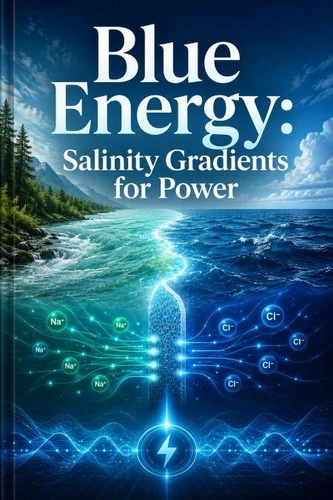
Blue Energy: Salinity Gradients for Power
Par :Formats :
Disponible dans votre compte client Decitre ou Furet du Nord dès validation de votre commande. Le format ePub est :
- Compatible avec une lecture sur My Vivlio (smartphone, tablette, ordinateur)
- Compatible avec une lecture sur liseuses Vivlio
- Pour les liseuses autres que Vivlio, vous devez utiliser le logiciel Adobe Digital Edition. Non compatible avec la lecture sur les liseuses Kindle, Remarkable et Sony
 , qui est-ce ?
Notre partenaire de plateforme de lecture numérique où vous retrouverez l'ensemble de vos ebooks gratuitement
Pour en savoir plus sur nos ebooks, consultez notre aide en ligne ici
C'est si simple ! Lisez votre ebook avec l'app Vivlio sur votre tablette, mobile ou ordinateur :

- FormatePub
- ISBN8235195578
- EAN9798235195578
- Date de parution13/05/2026
- Protection num.pas de protection
- Infos supplémentairesepub
- ÉditeurIoakim Ioakim
Résumé
Blue Energy: Salinity Gradients for Power is an informative and forward-looking book that explores one of the most fascinating yet lesser-known sources of renewable energy: the power hidden where freshwater meets saltwater. At river mouths, estuaries, deltas, coastal wastewater outlets, and desalination brine streams, nature creates a difference in salt concentration. This difference, known as a salinity gradient, contains usable energy.
The book explains how this quiet natural process can be transformed into electricity through science, engineering, and careful environmental planning. The book begins by introducing the reader to the hidden power found at the meeting point of rivers and seas. It explains how freshwater and seawater differ chemically, why salinity matters, and how dissolved ions create energy potential. In clear and bookish language, it presents the science of osmosis, osmotic pressure, ion movement, membranes, electrodes, and electrochemical systems.
These ideas are then connected to practical technologies such as pressure-retarded osmosis, reverse electrodialysis, capacitive mixing, and mixing entropy batteries. A major strength of the book is its balanced treatment of promise and challenge. Blue energy is presented not as a magical solution, but as an emerging renewable technology with real possibilities and serious obstacles. The book discusses the importance of advanced membranes, anti-fouling materials, durable electrodes, efficient pumps, corrosion-resistant equipment, and intelligent system design.
It also explains why laboratory success must be tested in real waters filled with sediment, microorganisms, organic matter, minerals, and changing environmental conditions. The book also gives careful attention to estuaries, deltas, and coastal ecosystems. It reminds the reader that river mouths are not empty industrial spaces; they are living habitats for fish, birds, shellfish, plants, and human communities.
Any blue energy project must therefore protect ecological balance, avoid harmful water withdrawal, manage discharge safely, and respect local livelihoods. This environmental perspective makes the book especially relevant in an age when clean energy must also be responsible energy. In addition to science and ecology, the book explores the economics of salinity gradient power. It explains why the resource itself may be free, but the machinery required to capture it can be expensive.
Membranes, electrodes, pumps, treatment systems, maintenance, permits, and grid connections all affect feasibility. The book considers how blue energy may become most useful when integrated with wastewater treatment plants, desalination facilities, industrial water streams, ports, and coastal microgrids. Finally, Blue Energy: Salinity Gradients for Power looks toward future innovations. It discusses nanomaterials, biomimetic membranes, porous carbon electrodes, digital monitoring, artificial intelligence, and hybrid renewable systems.
The book presents blue energy as one important member of a wider renewable energy family that includes solar, wind, hydro, geothermal, tidal power, and storage technologies. Overall, this book is a thoughtful guide to a quiet but powerful idea: that the natural difference between fresh and salty water can help create a cleaner energy future. It is ideal for readers interested in renewable energy, ocean technology, environmental science, engineering innovation, and sustainable development.
The book explains how this quiet natural process can be transformed into electricity through science, engineering, and careful environmental planning. The book begins by introducing the reader to the hidden power found at the meeting point of rivers and seas. It explains how freshwater and seawater differ chemically, why salinity matters, and how dissolved ions create energy potential. In clear and bookish language, it presents the science of osmosis, osmotic pressure, ion movement, membranes, electrodes, and electrochemical systems.
These ideas are then connected to practical technologies such as pressure-retarded osmosis, reverse electrodialysis, capacitive mixing, and mixing entropy batteries. A major strength of the book is its balanced treatment of promise and challenge. Blue energy is presented not as a magical solution, but as an emerging renewable technology with real possibilities and serious obstacles. The book discusses the importance of advanced membranes, anti-fouling materials, durable electrodes, efficient pumps, corrosion-resistant equipment, and intelligent system design.
It also explains why laboratory success must be tested in real waters filled with sediment, microorganisms, organic matter, minerals, and changing environmental conditions. The book also gives careful attention to estuaries, deltas, and coastal ecosystems. It reminds the reader that river mouths are not empty industrial spaces; they are living habitats for fish, birds, shellfish, plants, and human communities.
Any blue energy project must therefore protect ecological balance, avoid harmful water withdrawal, manage discharge safely, and respect local livelihoods. This environmental perspective makes the book especially relevant in an age when clean energy must also be responsible energy. In addition to science and ecology, the book explores the economics of salinity gradient power. It explains why the resource itself may be free, but the machinery required to capture it can be expensive.
Membranes, electrodes, pumps, treatment systems, maintenance, permits, and grid connections all affect feasibility. The book considers how blue energy may become most useful when integrated with wastewater treatment plants, desalination facilities, industrial water streams, ports, and coastal microgrids. Finally, Blue Energy: Salinity Gradients for Power looks toward future innovations. It discusses nanomaterials, biomimetic membranes, porous carbon electrodes, digital monitoring, artificial intelligence, and hybrid renewable systems.
The book presents blue energy as one important member of a wider renewable energy family that includes solar, wind, hydro, geothermal, tidal power, and storage technologies. Overall, this book is a thoughtful guide to a quiet but powerful idea: that the natural difference between fresh and salty water can help create a cleaner energy future. It is ideal for readers interested in renewable energy, ocean technology, environmental science, engineering innovation, and sustainable development.
A propos de Dilip Kumar Agrawal



2,99 €

2,99 €

2,99 €

2,99 €

2,99 €



2,99 €

2,99 €

2,99 €

2,99 €

2,99 €

2,99 €



2,99 €