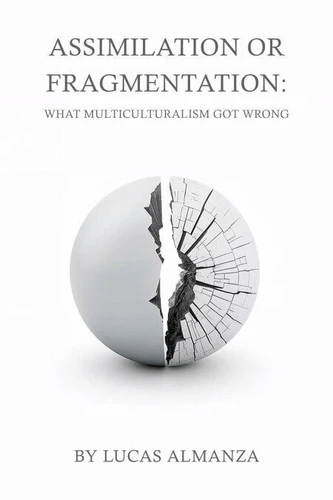
Assimilation or Fragmentation: What Multiculturalism Got Wrong
Par :Formats :
Disponible dans votre compte client Decitre ou Furet du Nord dès validation de votre commande. Le format ePub est :
- Compatible avec une lecture sur My Vivlio (smartphone, tablette, ordinateur)
- Compatible avec une lecture sur liseuses Vivlio
- Pour les liseuses autres que Vivlio, vous devez utiliser le logiciel Adobe Digital Edition. Non compatible avec la lecture sur les liseuses Kindle, Remarkable et Sony
 , qui est-ce ?
Notre partenaire de plateforme de lecture numérique où vous retrouverez l'ensemble de vos ebooks gratuitement
Pour en savoir plus sur nos ebooks, consultez notre aide en ligne ici
C'est si simple ! Lisez votre ebook avec l'app Vivlio sur votre tablette, mobile ou ordinateur :

- FormatePub
- ISBN8233832512
- EAN9798233832512
- Date de parution06/01/2026
- Protection num.pas de protection
- Infos supplémentairesepub
- ÉditeurLinda Balsamo
Résumé
We dreamed of a mosaic, but we built a map of walls. In the late 20th century, Western democracies embarked on a noble experiment: multiculturalism. The goal was social peace through the celebration of difference. Yet, thirty years later, the result is often a landscape of parallel societies, identity fatigue, and a deep-seated "confidence gap" in Western civilizational heritage. In Assimilation or Fragmentation, Lucas Almanza provides a provocative, analytical deep-dive into why the ideal of coexistence faltered and how the loss of a "common story" has left our societies fractured and polarized.
Almanza moves beyond the binary of bigotry versus open borders to examine the "Bureaucracy of Virtue"-the technocratic management of identity that has replaced real solidarity with symbolic performance. Drawing on case studies from London to Malmö, the book explores how official diversity policies often emphasize ethnicity over citizenship, creating cultural silos and a "mutual indifference" that erodes the foundations of democracy.
From the rise of populism to the limits of moral relativism, Almanza argues that the crisis of the West is not caused by the presence of the "Other, " but by the disappearance of a shared grammar of belonging. The solution, Almanza posits, is not a return to forced cultural erasure, but a "New Assimilation"-a confident pluralism anchored in shared civic norms, language mastery, and the defense of core liberal values.
By comparing Western struggles with pragmatic models from Singapore to India, this book offers a humane roadmap for rebuilding unity in a fractured age. Assimilation or Fragmentation is an essential read for anyone asking the defining question of our time: Can a society remain cohesive when it no longer shares a cultural center?
Almanza moves beyond the binary of bigotry versus open borders to examine the "Bureaucracy of Virtue"-the technocratic management of identity that has replaced real solidarity with symbolic performance. Drawing on case studies from London to Malmö, the book explores how official diversity policies often emphasize ethnicity over citizenship, creating cultural silos and a "mutual indifference" that erodes the foundations of democracy.
From the rise of populism to the limits of moral relativism, Almanza argues that the crisis of the West is not caused by the presence of the "Other, " but by the disappearance of a shared grammar of belonging. The solution, Almanza posits, is not a return to forced cultural erasure, but a "New Assimilation"-a confident pluralism anchored in shared civic norms, language mastery, and the defense of core liberal values.
By comparing Western struggles with pragmatic models from Singapore to India, this book offers a humane roadmap for rebuilding unity in a fractured age. Assimilation or Fragmentation is an essential read for anyone asking the defining question of our time: Can a society remain cohesive when it no longer shares a cultural center?
A propos de Lucas Almanza




3,49 €

4,49 €


4,49 €