Power rarely announces itself. It does not always arrive with force, nor does it depend solely on authority. In its most effective form, power becomes invisible-woven into systems, behaviors, and beliefs until it no longer needs enforcement. This is where occupation, in its broadest sense, begins. Occupation is not limited to territory. It extends into economies, information systems, identities, and even perception itself.
It operates through layered mechanisms-some obvious, many subtle-creating environments where control is normalized and resistance becomes difficult to organize. To understand occupation, one must move beyond surface-level explanations. This book introduces a systems-based approach: Breaking down control into layers Mapping how influence spreads through networks Identifying patterns that repeat across time and geography Examining both the mechanics of control and the psychology that sustains it But understanding is only the first step.
The later sections move into detection, strategy, resistance models, and ultimately reconstruction-because systems of control are not permanent. They are built, and therefore, they can be redesigned. This is not just a study of power. It is a manual for seeing clearly in environments designed to obscure.
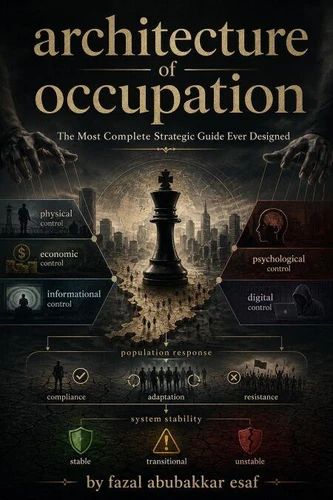
Power rarely announces itself. It does not always arrive with force, nor does it depend solely on authority. In its most effective form, power becomes invisible-woven into systems, behaviors, and beliefs until it no longer needs enforcement. This is where occupation, in its broadest sense, begins. Occupation is not limited to territory. It extends into economies, information systems, identities, and even perception itself.
It operates through layered mechanisms-some obvious, many subtle-creating environments where control is normalized and resistance becomes difficult to organize. To understand occupation, one must move beyond surface-level explanations. This book introduces a systems-based approach: Breaking down control into layers Mapping how influence spreads through networks Identifying patterns that repeat across time and geography Examining both the mechanics of control and the psychology that sustains it But understanding is only the first step.
The later sections move into detection, strategy, resistance models, and ultimately reconstruction-because systems of control are not permanent. They are built, and therefore, they can be redesigned. This is not just a study of power. It is a manual for seeing clearly in environments designed to obscure.


 , qui est-ce ?