Writes intellectual nonfiction about creativity, literature, and cultural memory.
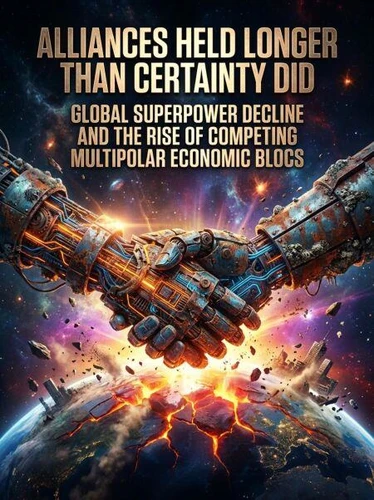
Alliances Held Longer Than Certainty Did. Global superpower decline and the rise of competing multipolar economic blocs
Par :Formats :
Disponible dans votre compte client Decitre ou Furet du Nord dès validation de votre commande. Le format ePub est :
- Compatible avec une lecture sur My Vivlio (smartphone, tablette, ordinateur)
- Compatible avec une lecture sur liseuses Vivlio
- Pour les liseuses autres que Vivlio, vous devez utiliser le logiciel Adobe Digital Edition. Non compatible avec la lecture sur les liseuses Kindle, Remarkable et Sony
 , qui est-ce ?
Notre partenaire de plateforme de lecture numérique où vous retrouverez l'ensemble de vos ebooks gratuitement
Pour en savoir plus sur nos ebooks, consultez notre aide en ligne ici
C'est si simple ! Lisez votre ebook avec l'app Vivlio sur votre tablette, mobile ou ordinateur :

- Nombre de pages220
- FormatePub
- ISBN978-3-565-47766-1
- EAN9783565477661
- Date de parution05/06/2026
- Protection num.pas de protection
- Taille1 Mo
- Infos supplémentairesepub
- ÉditeurEmphaloz Publishing House
Résumé
Every dominant power eventually confronts the limits of its reach. Military superiority can endure long after political confidence weakens, while economic rivals slowly reshape the balance of global influence from beneath established alliances and institutions.
This account investigates the structural pressures facing modern hyperpowers in an increasingly multipolar world. International military bases, naval presence, and regional partnerships once guaranteed unmatched strategic influence.
Yet growing economic competition, domestic polarization, and technological fragmentation gradually complicated the ability of any single state to maintain uncontested leadership. The book compares how major powers project influence across different regions through defense agreements, financial systems, and diplomatic networks. Emerging economic coalitions challenged older assumptions about global dependence on Western-led institutions, while internal social tensions weakened political consensus within established superpowers themselves. At the center lies a broader historical question: whether modern hegemony can survive when economic production, digital infrastructure, and political legitimacy become globally dispersed rather than centrally controlled. The changing international order appears here not as sudden collapse, but as a slow redistribution of influence across an unstable world system.
Yet growing economic competition, domestic polarization, and technological fragmentation gradually complicated the ability of any single state to maintain uncontested leadership. The book compares how major powers project influence across different regions through defense agreements, financial systems, and diplomatic networks. Emerging economic coalitions challenged older assumptions about global dependence on Western-led institutions, while internal social tensions weakened political consensus within established superpowers themselves. At the center lies a broader historical question: whether modern hegemony can survive when economic production, digital infrastructure, and political legitimacy become globally dispersed rather than centrally controlled. The changing international order appears here not as sudden collapse, but as a slow redistribution of influence across an unstable world system.
A propos de Natalie Harrington

9,99 €

9,99 €